








By Tatiana Martins, journalist at G&M News.
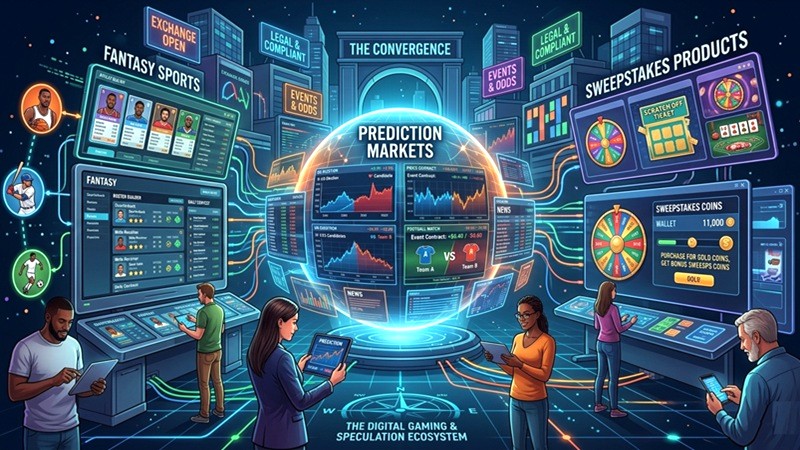
The lines between fantasy sports, sweepstakes products, prediction markets, and traditional betting are getting harder to define, and the industry is increasingly divided over what that means. While some operators see these products as a way to expand engagement and reach new audiences, established gaming interests argue that at least some of them are simply betting by another name and should be regulated as such.
This dispute has become one of the most important issues in U.S. gaming this year. Recent reporting has shown gaming associations pressing Congress to curb prediction markets, warning that sports event contracts can undermine state and tribal gaming rules, while major legal and regulatory fights continue to build around whether these products fall inside or outside gambling law.
In fact, yesterday, the Commodity Futures Trading Commission published a Notice of Proposed Rulemaking seeking public comment on amendments to CFTC Regulation 40.11 and the addition of Appendix F to part 40. The agency is particularly focused on whether existing CEA principles are sufficient or whether new regulations are needed to address unique risks in prediction markets. It also wants input on how existing exchange core principles should apply to prediction markets. Additionally, it seeks input on whether blockchain-based platforms need separate rules. The proposed rules lay out a menu of potential prediction markets regulations and open a 45-day public comment period once the Federal Register publishes them. During the comment period, the CFTC is asking whether prediction markets input on a variety of potential rules. The proposed rulemaking document is 267 pages.
Why the sector is colliding
Fantasy sports, sweepstakes and prediction markets share a common commercial logic: they all attract users through participation, competition, and the promise of an outcome tied to real-world events. But the way they are classified varies sharply, which is why they are now colliding with traditional sportsbooks and casino operators.
Fantasy sports have long operated as a gateway product, especially in North America, because they let users engage with sports through skill-based lineup selection and season-long competition. Sweepstakes products, meanwhile, have expanded as a lower-friction entry point in markets where regulated gambling options are limited or tightly controlled. Prediction markets have pushed the debate further by bringing event contracts into the conversation and raising the question of whether they are financial instruments, gambling products, or something in between.
The industry split
Not everyone in gaming sees the rise of these formats as a growth story. The American Gaming Association and the Indian Gaming Association have both urged Congress to stop sports event contracts from operating like unlicensed betting products, arguing that they compete directly with regulated gaming and threaten state and tribal revenue streams.
That opposition matters because it shows the industry is not unified. Some companies and investors see prediction markets as an innovative new category with national scale, while others view them as a regulatory loophole that puts pressure on licensed operators who already pay taxes, follow responsible gaming rules, and operate under stricter oversight.
Why operators still care
Even with that pushback, the commercial appeal is obvious. Prediction markets have drawn significant attention because they extend beyond sports and can reach consumers interested in politics, economics, and other public events, while fantasy and sweepstakes products continue to offer pathways into gaming for different user segments.
For operators, that means more than just another product line. It means a broader acquisition funnel, more chances to segment users by preference and more room to compete in jurisdictions where a single betting model may not be enough. It also helps explain why some gambling companies are now experimenting with their own prediction-style offerings, even as others lobby against them.
Regulation will decide the outcome
The real story is not whether these products are popular, but whether regulators and courts decide they belong inside gambling law, derivatives law or a separate category altogether. In the U.S., that question is already producing lawsuits, state-level objections, and growing congressional pressure.
Outside the U.S., the picture is also evolving. Canada has seen tighter scrutiny around predictive markets, and Europe is beginning to test whether licensing and clearer rulemaking can provide a framework for products that blur the line between betting and trading. Gibraltar’s first prediction market license is one sign that some jurisdictions are willing to explore that route.
The bigger takeaway
The overlap between fantasy sports, sweepstakes, prediction markets and traditional betting is not a neat convergence story. It is a live industry dispute over definitions, revenue, and regulatory control.
At the same time, the debate is also evidence of how fast the gaming market is evolving. New formats are making operators, regulators and lawmakers redraw boundaries in real time, and that makes this one of the most consequential industry stories of 2026.