








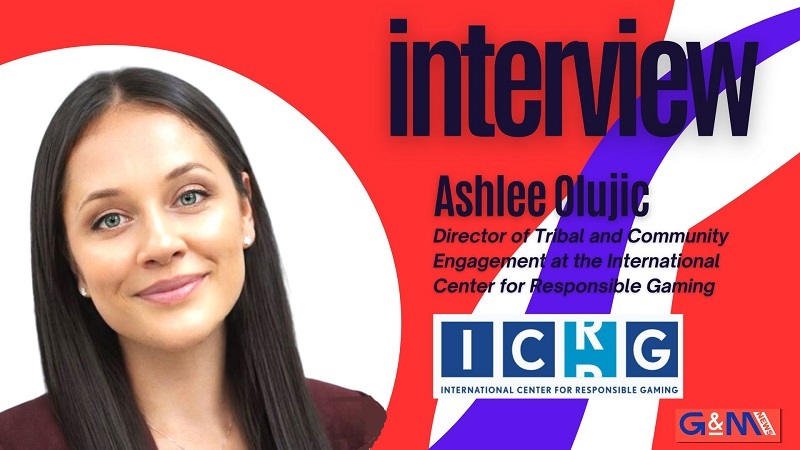
By Tatiana Martins, journalist at G&M News.
Tribal communities have unique histories, governance structures and cultural perspectives. What has been the most valuable lesson you have learned from working directly with Tribal leaders and communities on responsible gaming initiatives?
One of the biggest lessons I’ve learned is to leave my assumptions at the door. Through my work with Tribal communities, I’ve learned that meaningful engagement starts with listening rather than assuming. Every Tribal community has its own history, governance structure, priorities, and vision for its future. What works in one community may not work in another. Now, in my role at ICRG, I spend a lot of time listening to Tribal leaders, regulators, operators, educators, and community members. What I hear consistently is that communities don’t want solutions developed for them. They want to help shape the solutions themselves. I often think about this through the lens of Two-Eyed Seeing, bringing together Indigenous ways of knowing and Western research. One eye values data, evidence, and research. The other values community knowledge, lived experience, culture, and relationships. Neither is more important than the other. We need both to see clearly. At ICRG, that’s the approach we’re striving for. Tribal communities are the experts in their own experiences, and our role is to listen, learn, and help elevate those voices within the broader responsible gaming conversation.
In many conversations about responsible gaming, data and research take center stage. How do you ensure that community experiences and lived realities are given the same weight as academic findings?
I work for a research organization, so I have a deep appreciation for data and evidence-based decision-making. However, one thing I’ve learned through Tribal engagement is that data can never tell the whole story. I’ve never met a spreadsheet that could explain why a community rallied around a family in need, why a cultural program changed someone’s path, or why a young person chose a different direction because of a mentor, an Elder, or a connection to culture. Data matters, but so do stories. My background in Tribal engagement and Inclusive Leadership has reinforced the importance of creating space for multiple forms of knowledge. Academic research is one way of understanding the world. Community experience is another. Cultural teachings, storytelling, lived experience, and local context all bring valuable knowledge to the table. That’s why I don’t see this as an either/or conversation. It’s a both/and conversation. I often ask two questions: what does the data tell us? What are communities telling us? The strongest solutions emerge when those answers come together.
Building trust is often a long-term process. What does authentic engagement with Tribal communities look like in practice, and how can organizations avoid approaching these relationships as simply a box-ticking exercise?
I love this question because it’s something I think about almost every day. For me, authentic engagement starts long before a project, grant opportunity, research initiative, or conference panel. It starts with relationships. One thing I’ve learned over the years is that communities can tell the difference between a relationship and a transaction. If the only time you’re calling a Tribe is when you need a signature, a research participant, a funding partner, or a photo opportunity, people notice. Trust is built when communities know you’ll still be there after the meeting ends, after the project concludes, and after the funding runs out. One of the best examples of this was my father-in-law, Ernie Stevens Jr. He embodied authentic engagement better than almost anyone I’ve ever known. He showed up everywhere. Large Tribes, small Tribes, rural communities, urban communities, it didn’t matter. He understood that every community mattered and every relationship mattered. More importantly, he knew how to value people. He remembered names, families, stories, and accomplishments. People knew they weren’t just another stop on a schedule; they knew they were seen, heard, and respected. Watching that taught me that relationships are built one conversation, one visit, and one act of respect at a time. That lesson will stay with me forever. Authentic engagement means showing up consistently, listening more than speaking, respecting Tribal sovereignty, and creating opportunities for communities to help shape decisions that affect them. It also means shifting away from a deficit mindset. Instead of always asking “what’s wrong?” or “what needs to be fixed?”, we should also be asking “what strengths already exist here, and how can we build from them?”. The best partnerships I’ve experienced are the ones where communities aren’t viewed as stakeholders. They’re viewed as partners, leaders, and honestly, over time, friends.
The debate around RG is increasingly expanding beyond risk prevention to include overall well-being. How do you see community wellness shaping the future of responsible gaming programs?
I think this is one of the most exciting shifts happening in responsible gaming right now. I joke sometimes that responsible gaming has spent a lot of time living at the end of the spectrum. We’ve gotten very good at talking about what happens after someone is struggling. Those conversations are important and always will be, but what excites me is that we’re starting to spend more time at the beginning of the spectrum, prevention, education, wellness, and community support. Many Tribal communities have always approached issues through a holistic lens. Wellness isn’t just about an individual. It’s about families, culture, community, identity, and future generations. When we start talking about financial wellness, mental health, cultural connectedness, prevention, and community resilience, responsible gaming becomes part of a larger wellness ecosystem rather than a standalone program. I often describe responsible gaming as a spectrum. Prevention and education are at the beginning. Support and intervention are in the middle. Treatment and recovery are at the end. One of the things I’m most excited about at ICRG is the opportunity to support research across that entire spectrum, not just intervention and treatment, but prevention, education, and community wellness as well. The future isn’t choosing one part of the spectrum over another. It’s strengthening all of them while recognizing that healthy communities are one of the strongest forms of player protection.
If you could change one misconception that the broader gaming industry has about Tribal gaming operations and their approach to responsible gaming, what would it be and why?
I think one of the biggest differences between Tribal gaming and much of the broader gaming industry comes down to purpose. People often view Tribal gaming as a business. Tribal communities view it as a tool. For many Tribal communities, gaming is a tool for self-determination, economic development, and community well-being. The revenue doesn’t disappear into shareholders’ pockets. It helps fund government services, healthcare, education, housing, infrastructure, cultural preservation, language revitalization, elder programs, youth programs, and philanthropic efforts that benefit both Tribal and non-Tribal communities. When you understand that, responsible gaming takes on a different meaning. It’s not simply about compliance, a pamphlet on a counter, a phone number, or a self-exclusion program. Those tools are important, but they are only part of the picture. Many Tribal communities approach responsible gaming through a broader lens because they’re thinking about the very people and communities the enterprise was created to support. It’s about protecting players, certainly, but it’s also about protecting families, communities, cultures, and future generations. That’s one reason I’m so passionate about bringing more Tribal voices into the responsible gaming conversation. As conversations around sports betting, prediction markets, and emerging gaming products continue to evolve, Tribal communities have an opportunity to help shape what comes next. Not because Tribal communities have all the answers, but because they bring a perspective rooted in stewardship, responsibility, community wellness, and thinking beyond the next quarter or the next fiscal year. I believe some of the most important conversations in responsible gaming are shifting from problems to solutions and strengths already existing within our communities. To me, that is sovereignty in action. I think this may be one of the most important contributions Tribal gaming can make to the future of responsible gaming.