





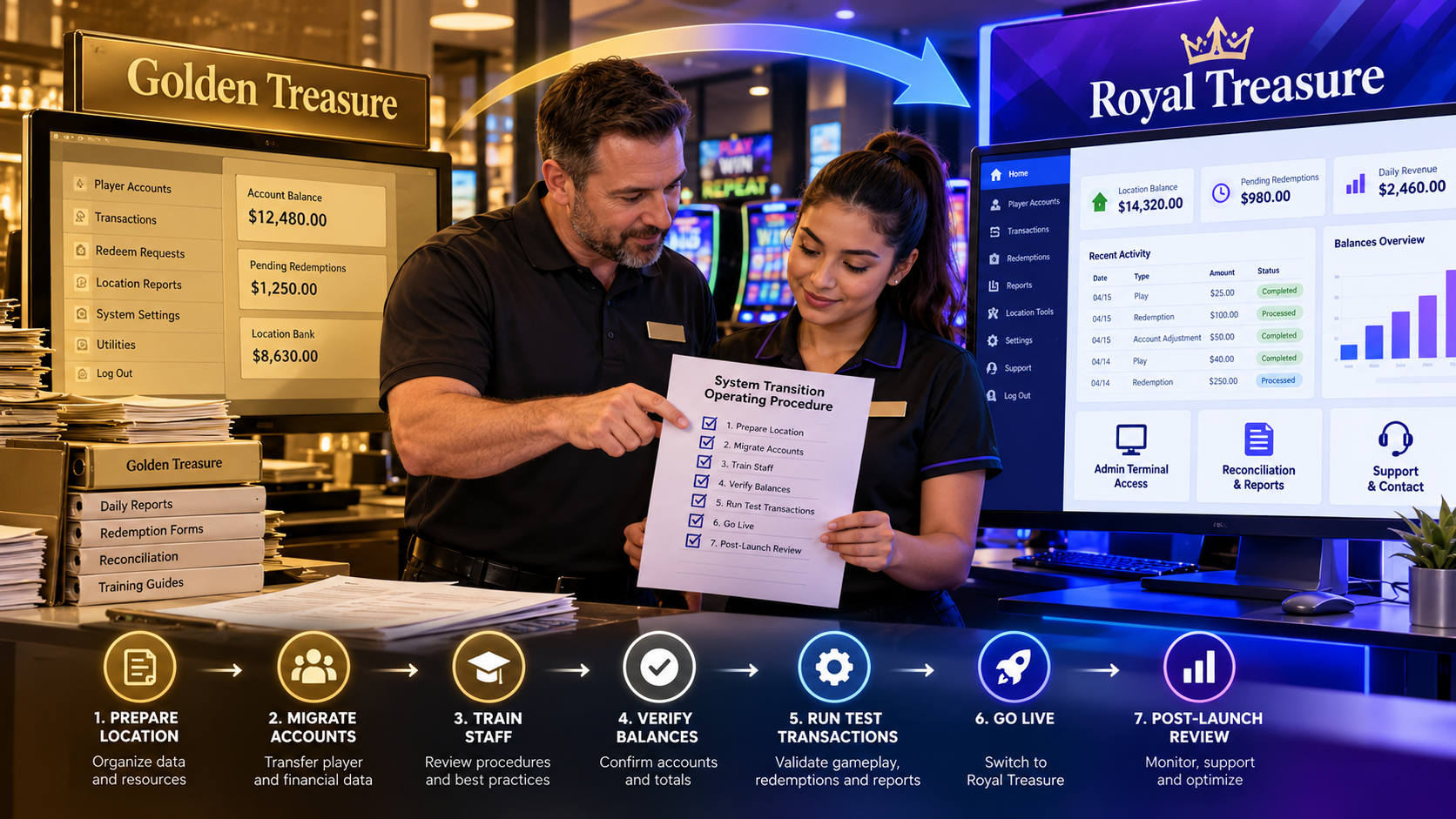
For the owner of a gaming location, a platform transition is rarely just a software decision. It is a change in the instructions that cashiers follow, the information that agents provide and the way the business records its day-to-day activity. A familiar name may disappear from a current supplier catalog while staff are still working with the earlier system.
That is the situation operators may encounter as Golden Treasure is succeeded by Royal Treasure. Glamour Spin and Royal Vault represent another transition in the same group of platform changes. The commercial opportunity for a distributor is to present current systems; the operational task for a business is to distinguish a current product from an older account that may still require attention.
Define what is changing at the location
Start with the existing operation, not with the new screen. Does the location have a primary agent account? Do employees work through other account levels? Who purchases points, who reconciles the balance, and who handles customer-service requests? These questions form the baseline against which any proposed new platform can be assessed.
Royal Treasure is identified by Whale Sweepstakes as the current replacement for Golden Treasure. Its listing describes a prepaid point-based model and a browser-accessible admin terminal. The Royal Treasure gaming system page also invites businesses to request backend demonstrations and confirm setup arrangements. These facts are useful, but they do not establish that a Golden Treasure login or its historical data can be transferred without additional steps.
Keep legacy balances separate from new orders
One of the easiest mistakes in a transition is to mix three different questions: Can an old balance still be used? Can the old balance be moved? Can new credits be purchased on the older platform? An operator should obtain a specific answer to each question.
During the earlier transition communication, distributors were advised that new purchases and top-ups for the old systems had stopped, while previously acquired balances could continue to be used. Transfer rules also depended on account level. These were reported transition conditions, not a guarantee that every account still has the same status today. Before staff act, the supplier should confirm the current position in writing.
Give cashiers a one-page operating procedure
A simple shift guide should record which system is being used, which account is authorized, how to contact support, and where staff should document a balance question. When two versions are present during a transition, the guide should clearly distinguish the old and new processes. The worst outcome is a cashier following an instruction intended for a different account.
Managers should make the procedure easy to verify. Avoid vague instructions such as “use the new backend.” Include the correct system name, the approved access route, the employee responsible for checking the account and the escalation contact. Sensitive credentials should be stored through the business’s approved method rather than printed on an open counter.
Use a supplier demonstration to answer operational questions
Royal Treasure’s published description covers the administrative interface and access methods, but an in-person or remote demonstration should focus on the tasks the location actually performs. Ask who initiates an order, how a balance addition is confirmed, whether planned kiosks need a particular configuration, and what information staff should provide when requesting technical assistance.
Businesses evaluating Royal Vault as the successor to Glamour Spin should conduct the same exercise independently. The new platform’s name does not tell the buyer whether hardware compatibility, staff permissions or service procedures match those of Royal Treasure. Different product listings need different evidence.
Sequence the change instead of improvising it
A practical transition plan identifies a decision-maker, a supplier contact and a target date for each step. First document outstanding balances and active account relationships. Next confirm the successor-platform order and demonstrate the daily workflow. Then train one responsible staff member and verify the procedure before rolling it out to other shifts or locations.
The plan should include an issue log and a way to stop or adjust the rollout if a key requirement has not been satisfied. This is standard operational discipline rather than a promise that a particular software product will eliminate downtime.
From a software listing to an informed purchase
Distributors such as Whale Sweepstakes can serve as a starting point for comparing legacy and replacement systems, requesting platform information and discussing the setup for a particular retail operation. The buyer’s responsibility is to request precise terms and make sure those terms reach everyone who works with the system.
Finally, product selection and legal approval are separate questions. Operators should review their specific sweepstakes or skill-game model with appropriately qualified counsel in each relevant jurisdiction. The move from Golden Treasure to Royal Treasure is most useful when it prompts a clearer internal process, not merely a new name on the shop’s software list.