








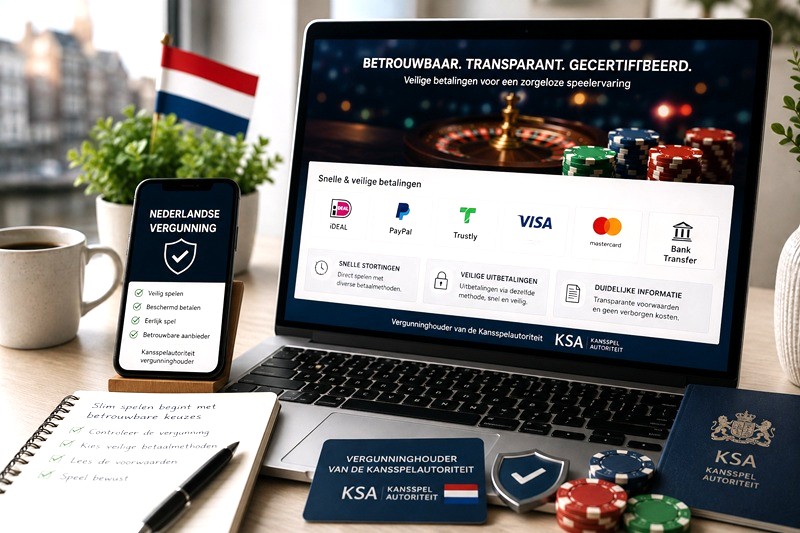
While operators invest heavily in compliance, responsible gambling and player protection, fraudsters increasingly see opportunities to misuse well-known casino brands, licences and promotions. That makes online fraud not only a consumer problem, but also a challenge for the industry itself.
When people think of online fraud, they usually think of phishing emails, fake web shops or stolen bank details. But the online gambling market is increasingly affected by it too. Fraudsters abuse well-known casino brands, copy promotions and set up websites that, at first glance, are barely distinguishable from the real thing.
Luc, can you briefly introduce yourself and explain what oplichting.com does exactly?
Of course. I’m an editor and analyst at oplichting.com, and as an iGaming specialist I’ve been following developments in the Dutch online gambling market for years.
Oplichting.com has now existed for more than ten years and has always focused on informing consumers. Within the gambling market we do that by helping visitors find their way in safe and responsible online gambling. We write about licences, player protection, responsible gambling, bonuses, payment methods and developments within the regulated Dutch market.
We also devote a great deal of attention to online fraud in the broadest sense of the word. On our website, visitors find information about phishing, identity fraud, fake web shops, investment fraud and all kinds of other forms of internet scams.
That gives us an interesting position. We don’t just follow what happens within the legal gambling market; we also see how fraudsters try to take advantage of the trust that well-known brands and licences have built up.
You’ve followed the Dutch gambling market for years, but you also write a lot about online fraud. When did you start to notice that those two worlds were increasingly overlapping?
Oplichting.com was actually already active within the online gambling world before online fraud became such an important topic on the website. The original goal was very simple: to help players find their way through the online offering and inform them about safe and responsible play.
That became even more relevant when the Netherlands legalised online gambling in 2021. Suddenly, players had to learn what a licence from the Netherlands Gambling Authority (Kansspelautoriteit) actually meant, which casinos were legal and which were not. Oplichting.com played an informative role in that by closely following developments in the market and explaining complex regulations in an understandable way.
As a writer, I originally started with outreach articles about online fraud. I wrote about phishing, fake web shops, identity fraud and other forms of internet scams that consumers deal with on a daily basis.
At the same time, my interest in the iGaming sector grew. What appealed to me was the combination of technology, regulation, marketing and consumer protection.
As I specialised further in the sector, something else began to stand out to me. The worlds of iGaming and online fraud were moving closer and closer together. Fraudsters discovered that well-known casino brands, licences and promotions were perfectly suited to misleading consumers.
What stands out to you most at the moment when you look at online fraud in general?
How professional it has all become. Ten years ago, you could recognise a lot of fraud by poor language, amateurish websites or emails full of spelling mistakes. That’s no longer the case today. Some fraudulent websites look better than those of legitimate companies.
There’s investment in design, customer service, marketing and even search engine optimisation. At first glance, everything looks trustworthy. That makes things much harder for consumers. Where vigilance used to be enough, today it often takes some extra research to find out who you’re really dealing with.
Something else I find striking is that fraud is increasingly becoming part of a complete marketing funnel. A victim doesn’t just end up on a fraudulent website out of nowhere. It often starts with an advertisement on social media, followed by a professional-looking landing page and then contact via email or WhatsApp.
Do you see that same professionalisation within the online gambling sector?
Absolutely. In fact, I think the gambling sector has become an attractive target precisely because consumers are already used to creating online accounts, uploading documents and making payments.
A few years ago, reports were usually about obscure foreign casinos or disputes over payouts. Today we increasingly see parties that deliberately pose as an existing brand.
We see copied websites, fake advertisements on social media and promotions that look as if they come from a legitimate operator. Sometimes fraudsters even use licence details or company information taken directly from real businesses.
Sometimes we get messages from consumers who are a hundred percent convinced they played at a well-known casino. Only when something goes wrong and we dig deeper into the case does it turn out they ended up on a different website. Fortunately, that kind of situation doesn’t happen every day, but it does show how convincing some fraudsters have become.
Can you give an example of signals that immediately strike you as suspicious?
When we investigate a website, we usually start with the basics. Are the licence details correct? Who’s behind the company? How old is the domain? And are the contact details logical and verifiable? Those kinds of questions often yield a lot of information already.
In doing so, we always draw a clear distinction between legal operators and parties that mainly try to come across as trustworthy. It may seem minor, but for consumers it can make all the difference.
Casinos with a licence from the Netherlands Gambling Authority are under strict supervision. They must comply with rules around advertising, player protection, identity verification and transparency. That’s precisely why many of the signals that set off alarm bells for us show up far more often with parties operating outside the regulated market.
In practice, it’s rarely one single element that makes a website suspicious. Usually that feeling arises from an accumulation of small things. A bonus that looks rather too generous. Terms and conditions that remain strikingly vague. A customer service team reachable only via Telegram. An address that can’t be found anywhere. Or a domain name that was only recently registered while the website claims to have been active for years. Individually those things may mean little, but together they often form a clear picture.
Why should operators and affiliates be concerned about these kinds of practices?
Because consumers usually don’t see what happens behind the scenes.
When someone is scammed by a website that closely resembles a well-known brand, it’s mainly that brand name that sticks. The average player doesn’t go and investigate which party was actually responsible.
From the consumer’s perspective, there’s often only one conclusion: something went wrong at the brand they thought they were visiting. Whether that brand was actually involved then becomes almost irrelevant. For operators, that can lead to reputational damage, negative reviews or complaints on social media. Affiliates can face the same problem when their brand name is used in misleading advertisements or fraudulent campaigns.
Trust is one of the most important currencies within the online gambling industry. Once that trust declines, ultimately the whole sector feels the consequences.
Do you think that risk is taken seriously enough?
I think attention to it is growing, but there’s still room for improvement. Many companies rightly invest a lot of time and resources in compliance, responsible gambling and regulation. Those are important parts of a healthy market. At the same time, I see that brand abuse is sometimes still viewed as a marketing problem, when it’s actually a combination of reputation management, consumer protection and cybersecurity.
Larger brands in particular increasingly face parties trying to ride on their name recognition. I expect this will only increase in the coming years. Not because operators are doing something wrong, but simply because successful brands are attractive to fraudsters.
Do you see any other trends the sector needs to take into account?
What strikes me is that fraud is becoming increasingly spread across different channels. In the past, a scam often started and ended on a single website. Today the process runs across multiple platforms.
A player sees an advertisement on social media, then receives a message via WhatsApp, ends up on a professional-looking website and is subsequently approached by someone posing as a customer service employee.
Each step on its own seems credible. It’s precisely that combination that makes it so effective.
On top of that, we see that fraudsters increasingly understand how consumers think. They play on urgency, exclusivity and trust. Those are techniques that are also used in legitimate marketing, but there, of course, within clear rules and frameworks.
Looking ahead to the coming years, what should operators and affiliates keep in mind?
When I look at recent years, I really only see one direction. The websites are getting better. The advertisements are getting more credible. The technology is becoming more accessible.
I also strongly believe in collaboration. Operators, affiliates, regulators and consumer platforms all hold different pieces of information. When that knowledge is shared, new threats can be recognised much faster.
After all, no one has the complete picture.
Finally, what would you like to leave the sector with?
That fraud isn’t only a consumer problem. Every successful scam erodes the trust that the regulated market ultimately runs on. And trust is something you build over years but can lose in a short time.
I think operators, affiliates and consumer platforms ultimately have more common interests than is sometimes assumed. We all want players to end up in a safe environment where they know who they’re doing business with.
The smaller the space for fraudsters becomes, the stronger trust in the sector as a whole will be. And in the end, everyone benefits from that.