








By Tatiana Martins, journalist at G&M News.
With the maturation of regulated betting markets, advertising is becoming an important part of the industry’s regulatory development. Rather than simply determining whether operators can advertise, regulators are establishing more detailed frameworks for how betting products can be promoted, which audiences can be reached, and what information consumers should receive.
The result is a diverse international landscape. Some jurisdictions continue to allow advertising across television, digital media, and sports sponsorships under strict conditions. Others have introduced significant restrictions on commercial communications, while a smaller group has opted for broad advertising prohibitions.
Across these different models, however, a common objective is emerging: creating an environment in which licensed operators can compete while advertising is conducted responsibly and consumers are better protected. The evolution is visible in the way regulators are addressing digital marketing, influencers, affiliates, sponsorships, responsible-gambling messages and advertising directed towards younger audiences.
For international operators, understanding these differences is becoming an essential part of working successfully across regulated markets.
United Kingdom: Building responsible advertising standards in a mature market
The UK remains one of the world’s most established regulated betting markets, with advertising permitted across a wide range of media under a comprehensive set of rules. Gambling advertising must comply with the UK Advertising Codes developed by the Committees of Advertising Practice (CAP), while the Gambling Commission establishes requirements for licensed operators through its Licence Conditions and Codes of Practice. These rules cover marketing communications, promotional offers, direct marketing and the presentation of significant terms and conditions.
The regulatory model allows operators to build brands and communicate with consumers while placing significant emphasis on responsible marketing. Protection of children and young people has become an important enforcement priority. In June 2026, the Advertising Standards Authority issued an enforcement notice concerning gambling advertisements with strong appeal to under-18s, particularly on social media. The regulator announced active monitoring and targeted enforcement from June 11th, 2026.
The development illustrates how the UK’s mature market continues to refine its advertising framework. The focus is on the quality of targeting and creative execution, rather than on preventing regulated operators from communicating with the adult betting audience altogether.
Spain: Strengthening transparency while supporting a regulated environment
Spain has developed one of Europe’s more structured approaches to gambling advertising, combining market access with detailed restrictions on commercial communications. Under Royal Decree 958/2020, advertising on audiovisual media is subject to strict time restrictions, while digital communications must comply with requirements designed to prevent exposure among minors and other protected groups.
The regulatory framework is still evolving in 2026. On October 6th, Spain’s Official State Gazette published technical specifications for mandatory warning messages concerning the harmful effects of gambling addiction or risky behavior, as well as messages concerning the prohibition on participation by minors.
This new system strengthens the information available to consumers. Depending on the advertising format, gambling communications will have to include specific warnings concerning gambling risks and direct users towards safer-gambling resources. Spain’s approach demonstrates how advertising regulation can evolve alongside a legal betting market, adding layers of transparency and consumer information without removing regulated operators from the commercial environment.
Italy: A restrictive model with limited room for commercial promotion
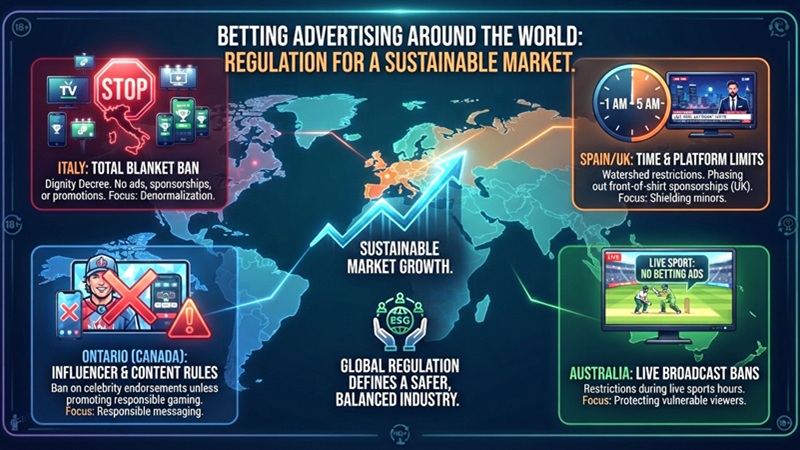
Italy represents one of Europe’s most restrictive approaches to gambling advertising. The country’s Dignity Decree prohibits advertising and indirect advertising for gambling and betting with cash prizes across a broad range of media. The prohibition covers television, radio, print, outdoor advertising, digital channels and social media, as well as sporting, cultural and artistic events.
The framework also places responsibilities on different participants in the advertising chain, including advertisers, media owners and event organizers. Despite the broad prohibition, regulatory work continues around consumer protection. In 2026, Italy’s Communications Authority, AGCOM, approved an additional act concerning guidelines for communication campaigns addressing gambling-related disorders.
Italy therefore provides an important contrast with markets where advertising is permitted. Its experience demonstrates that responsible-gambling communication and commercial advertising can be treated as separate regulatory categories.
France: Balancing market visibility with consumer protection
France has maintained a regulated betting advertising environment while placing strong emphasis on controlling advertising pressure. The National Gambling Authority, ANJ, reviews operators’ promotional strategies and can impose conditions on their marketing activities. This approach allows operators to promote their products while requiring them to consider the potential impact of advertising volume and frequency.
The issue became relevant in 2026 because of the FIFA World Cup. The ANJ reported that operators had increased their promotional budgets by more than 25% for the year, citing the strong sporting calendar and competition in the online market. The regulator approved the strategies subject to conditions, including a requirement that operators do not exceed their announced overall budgets.
Digital media accounted for 44% of promotional spending in the strategies reviewed by the ANJ, while sports sponsorship also increased. The regulator’s approach therefore does not eliminate commercial activity but seeks to ensure that promotional competition remains compatible with consumer protection objectives. France illustrates a model in which a mature regulated market can maintain strong commercial visibility while introducing mechanisms designed to moderate excessive advertising pressure.
Australia: Establishing clear rules across multiple advertising channels
Australia has developed a detailed advertising framework covering television, radio, online services and live sports. The Australian Communications and Media Authority, ACMA, applies specific rules to gambling advertising during children’s programming, live sports broadcasts and sports streamed online. The framework also addresses misleading or socially irresponsible advertising and the promotion of illegal online gambling.
The regulator has also highlighted the responsibilities of social media influencers and platforms, reflecting the complex structure of digital marketing.
For operators, Australia’s system reinforces the importance of understanding the specific requirements associated with each advertising channel. Rather than relying on a single advertising standard, the market operates through a network of rules designed around different forms of media and different levels of audience exposure.
United States: Adapting advertising standards to a rapidly evolving market
The United States presents a different regulatory challenge because sports betting is primarily regulated at state level. Licensed sportsbooks therefore operate under a combination of state and tribal requirements, with responsible-gaming and advertising standards varying across jurisdictions.
Currently, the American Gaming Association’s Responsible Gaming Code of Conduct provides an industry framework, but operators must also comply with the rules of each state in which they operate. The advertising environment is changing again in 2026 as prediction-market platforms expand their presence in sports-related event contracts.
The American Gaming Association reported in August 2026 that prediction-market platforms had spent nearly USD 200 million on digital advertising during the first seven months of 2026. According to the association’s analysis, 57% of digital sports betting advertisements seen during the year were associated with prediction markets rather than traditional online sportsbooks.
This development has generated debate about whether different categories of sports-related products should operate under comparable consumer-protection standards. From an industry perspective, the U.S. illustrates how regulation must continue adapting as technology and product structures evolve.
A global shift towards more accountable betting advertising
Despite substantial differences between jurisdictions, the international direction is becoming clear. Protection of minors is now one of the most consistent priorities. Regulators are examining not only whether an advertisement explicitly targets children but also whether its imagery, creative style, influencer partnerships or placement could strongly appeal to under-18 audiences.
Digital targeting is another major area of development. The Netherlands, UK, Germany and other markets are focused on how operators identify and control the audiences exposed to gambling advertising.
Influencers and affiliates are also becoming part of formal regulatory conversation. As marketing moves away from traditional advertising formats, regulators are considering whether third-party content can function as gambling advertising even when it is presented as entertainment, lifestyle or personal content.
Responsible-gambling messaging is becoming more prominent. Spain’s 2026 warning requirements illustrates a move towards giving consumers more explicit information about gambling risks.
Advertising pressure is also receiving greater attention. France’s review of promotional budgets during the 2026 World Cup demonstrates that regulators are looking beyond individual advertisements and examining the overall intensity of marketing campaigns.
At the same time, regulated advertising continues to perform an important role in mature markets. It allows licensed operators to establish recognized brands, communicate with adult consumers and differentiate authorized services from illegal alternatives. This distinction may become important as regulators attempt to channel consumers to supervised markets.
The future of betting advertising is therefore unlikely to be defined simply by a choice between unrestricted promotion and prohibition. Instead, the emerging model is one of regulated visibility: allowing licensed operators to compete while establishing sophisticated safeguards around audiences, content, targeting, and responsible-gambling information.
For international betting companies, this means that compliance is becoming a strategic component of marketing. Campaigns need to be designed from the outset around local regulatory requirements, platform-specific restrictions and consumer-protection objectives.
As regulated markets mature, effective advertising will therefore depend on more than reach. It will depend on the ability to combine commercial communication, responsible marketing, and regulatory compliance in a way that supports a sustainable legal market.