





See more of G&M News on Google
Add as a preferred source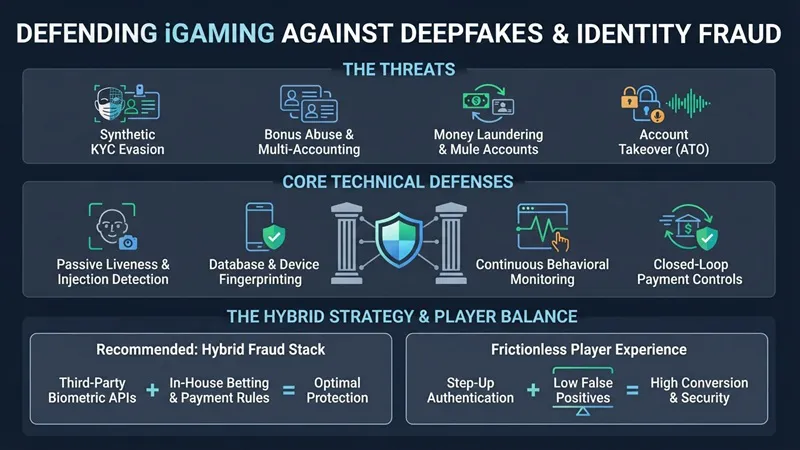
By Tatiana Martins, journalist at G&M News.
Artificial intelligence is making identity fraud more sophisticated and harder to detect. Deepfake videos, manipulated identity documents, synthetic identities, and biometric spoofing can be used to bypass verification procedures, create fraudulent accounts or gain unauthorized access to existing ones. For iGaming operators, these threats raise concerns that extend beyond cybersecurity, affecting regulatory compliance, financial integrity, player protection and brand reputation.
The challenge is not simply to identify manipulated images or videos. Operators need to assess whether the person registering, accessing an account or requesting a financial transaction is genuinely the individual they claim to be. This requires a combination of reliable identity verification, continuous monitoring, secure authentication and well-defined procedures for responding to suspicious activity.
The National Institute of Standards and Technology (NIST), in its Digital Identity Guidelines published in 2025, addresses identity proofing, authentication and presentation attack detection. Although the framework was developed for digital identity systems more broadly, its recommendations offer useful technical references for operators evaluating their own verification processes.
- Strengthen identity verification from the registration stage
The first line of defense begins when a player creates an account. Traditional Know Your Customer (KYC) procedures, based primarily on document submission and static facial comparison, may be insufficient when criminals can manipulate images or generate convincing identity materials.
Operators should adopt layered verification processes that combine document authenticity checks, facial comparison and liveness detection. These systems should assess whether the document is genuine, whether the face matches the identity information and whether the biometric sample comes from a live person physically present during the verification process.
Liveness detection is important because it helps identify attempts to use photographs, prerecorded videos, masks or other artificial representations to impersonate legitimate users. Operators should evaluate whether their technology has been independently tested against presentation attacks and whether its performance is appropriate for remote onboarding.
NIST’s 2025 guidance recommends presentation attack detection for remote biometric collection and references ISO/IEC 30107-3:2023 as a standard for testing these capabilities. Operators should use such technical benchmarks when assessing providers rather than relying solely on vendors’ marketing claims.
- Do not rely on a single verification method
Even sophisticated biometric tools can have limitations. A system that performs well against one type of manipulation may be less effective against another, as generative AI tools evolve.
For this reason, operators should avoid making high-risk decisions based on a single verification signal. A facial match, for example, should not automatically authorize every subsequent account activity or financial request.
A stronger approach combines several independent checks, including document validation, biometric verification, device intelligence, account history and consistency between identity and payment information. The level of scrutiny can also be adjusted according to the risk of the activity.
For example, an ordinary login from a recognized device may require a different verification process from a withdrawal request involving a newly registered payment method, an unusual location or a recent change in account details.
This risk-based approach helps operators concentrate additional controls where the potential for fraud is higher without creating unnecessary barriers for legitimate players.
- Protect existing accounts against impersonation and takeover
Identity fraud does not end when an account has been approved. Criminals may use stolen credentials, manipulated biometric material or social engineering to take control of existing accounts.
Operators should therefore implement strong authentication measures, including multifactor authentication where appropriate, secure password recovery procedures and additional verification for sensitive account changes. Changes to registered email addresses, telephone numbers, payment methods and withdrawal details deserve particular attention.
Behavioral monitoring can also help identify unusual activity. Relevant signals may include repeated login failures, access from unfamiliar devices, abrupt changes in geographical patterns, multiple accounts sharing technical characteristics or withdrawal attempts shortly after changes to account credentials.
No individual signal should automatically be treated as proof of fraud. However, combinations of unusual events can justify additional verification, temporary restrictions or a review by the security team.
Operators should also establish procedures to protect players who report account compromise. A clear recovery process, accessible customer support and rapid investigation can limit financial losses and prevent further unauthorized activity.
- Monitor suspicious patterns across accounts and transactions
Fraudsters may attempt to distribute their activities across several accounts to avoid detection. Synthetic identities, stolen personal information and accounts controlled by third parties can make it harder to identify the individual behind a transaction.
Operators should therefore monitor activity across their platforms rather than evaluating every account in isolation. Relevant controls include identifying repeated use of the same payment instruments, devices or technical identifiers across multiple accounts, unusual deposit and withdrawal patterns, and inconsistencies between verified identity information and transaction behavior.
These controls should be integrated with existing Anti-Money Laundering (AML) and fraud-prevention procedures. When suspicious activity is detected, operators need documented escalation processes, appropriate investigation records and reporting procedures aligned with the legal requirements of each jurisdiction.
An alert issued by the US Financial Crimes Enforcement Network (FinCEN) in November 2024 highlighted how generative AI can be used to create fraudulent identity documents and circumvent verification methods. It also identified warning signs such as inconsistencies between identity documents and attempts to manipulate verification sessions. Although the alert addresses financial institutions, its risk indicators are relevant to other businesses that rely on remote identity verification and financial transactions.
- Evaluate technology providers beyond their detection claims
Many operators depend on external companies for identity verification, biometric authentication, fraud detection and transaction monitoring. Selecting these providers requires more than comparing features or processing speeds.
Operators should examine how solutions are tested, which types of attacks they can detect, how frequently detection models are updated and whether their performance has been independently assessed. It is also important to understand how providers handle false positives, protect biometric information and respond when a new fraud technique emerges.
Contracts should clearly define responsibilities for data security, incident notification, audit access, information retention and cooperation during investigations. Operators should also establish procedures for reviewing provider performance over time instead of treating the initial integration as a permanent guarantee of security.
A technology provider’s ability to explain the limitations of its solution is as important as its ability to demonstrate successful detection. No single tool can eliminate identity fraud, and operators should be wary of products presented as offering complete protection against deepfakes.
- Train employees to recognize AI-enabled social engineering
Technical controls are only part of the response. Fraudsters may also use synthetic voices, manipulated videos or impersonation techniques to deceive customer service representatives, compliance teams and even senior employees.
An individual posing as a player, company executive or business partner may attempt to obtain account access, request changes to payment information or persuade an employee to disclose confidential data.
Operators should establish clear verification procedures for sensitive requests received through email, messaging applications, telephone calls or video conferences. Employees should never rely solely on the apparent identity of the person communicating with them.
Training should cover common social engineering techniques, suspicious requests, escalation channels and the importance of verifying instructions through an independent communication channel. Internal procedures should also require additional authorization for high-risk actions, particularly those involving payments, account recovery or access to sensitive systems.
- Balance fraud prevention with privacy and player experience
More extensive identity checks can improve security, but they also involve the collection and processing of sensitive personal and biometric information. Operators must ensure that additional controls comply with applicable data protection laws and that information is collected and retained only for legitimate purposes.
Privacy considerations should be incorporated into system design from the beginning. This includes defining access permissions, protecting stored information, setting retention periods and ensuring that technology providers follow appropriate security standards.
Operators should also monitor false rejection rates and assess whether verification systems perform consistently across different demographic groups. A legitimate player should not be unfairly blocked because a biometric system produces an inaccurate result.
When additional verification is necessary, the process should be explained clearly, with accessible support and a reasonable way to challenge an incorrect decision. Security measures are more effective when players understand their purpose and can complete them without unnecessary friction.
- Build a coordinated response plan
Preventing every attempt at identity fraud is unrealistic. Operators should therefore prepare for incidents involving compromised accounts, fraudulent registrations, manipulated documents and suspected deepfake activity.
A response plan should define the responsibilities of security, compliance, customer support, payments and legal teams. It should also establish how suspicious accounts are reviewed, when withdrawals or account changes may be temporarily restricted, how affected players are contacted and which incidents must be reported to authorities or regulators.
Regular testing is essential. Simulated fraud scenarios can help identify weaknesses in onboarding, account recovery, employee procedures and communication between departments. The results should inform updates to technical controls and staff training.
The objective is to reduce the time between detecting suspicious activity and taking appropriate action, while preserving evidence and treating legitimate players fairly.
Security as an ongoing operational responsibility
Deepfakes and AI-enabled identity fraud are changing the threat landscape for digital businesses, including iGaming. Operators can no longer treat KYC as a one-time administrative step completed during registration. Identity assurance must remain part of the account lifecycle, supported by authentication, transaction monitoring, employee awareness and continuous assessment of technology providers.
The most resilient approach combines several layers of protection rather than relying on a single biometric tool or automated fraud score. By integrating security, compliance, data protection and player support, operators can make fraudulent activity more difficult while maintaining a trustworthy experience for legitimate customers.
As AI-generated content becomes more accessible, the ability to verify identities reliably and respond quickly to suspicious behavior will be an important part of operating a secure and sustainable iGaming platform.