







By Tatiana Martins, journalist at G&M News.
The gambling market in Denmark is entering a new regulatory phase, supported by a mature licensing system, strong digital participation, and a political agenda focused on player protection. Online casino and sports betting remain central to the sector, while new legislation proposed in October 2026 could reshape advertising practices, affiliate partnerships and the supervision of unlicensed operators from 2027.
The country’s regulatory framework has evolved since the partial liberalization of its market in 2012. That reform opened online casinos and betting to licensed private operators, while lotteries remained largely under a state-controlled model. The Danish Gambling Authority (DGA), known locally as Spillemyndigheden, oversees licensing, compliance and market supervision.
The next phase will test how Denmark balances commercial competition with stricter standards for advertising, consumer protection and responsible play.
Online casino takes the lead in Denmark’s iGaming market
The latest annual figures confirm the importance of digital products to Denmark’s gaming sector. According to the DGA’s The Gambling Market in Numbers 2025, published on June 29th, 2026, online casino generated DKK 4.309 billion (€576.5 million) in gross gaming revenue (GGR) in 2025, becoming the country’s largest gaming category for the first time. State-monopoly lotteries, including Lotto, class lotteries and scratch cards, generated DKK 3.492 billion (€467.2 million). This marked a significant shift in a market where lotteries had historically ranked first. The figures also show that 73% of all gaming activity took place on computers or mobile devices in 2025, up from 70% in 2024.
In this sense, the broader market had already recorded a recovery in 2024, when total GGR reached DKK 11 billion (€1.47 billion), compared with DKK 10.4 billion (€1.39 billion) in 2023, according to the DGA’s annual report. Online casino grew from DKK 3.119 billion (€417.3 million) to DKK 3.529 billion (€472.2 million) during that period, while betting revenue remained broadly stable at approximately DKK 2.2 billion (€294.3 million).
Monthly figures also indicate continued activity in 2026. The DGA reported that total gaming spend in July 2026 rose 17.2% year on year. Online casino revenue increased 22%, while betting grew 21.3%. These monthly comparisons provide a snapshot of market performance rather than a full-year forecast.
A licensing model built around oversight and competition
Denmark’s licensing framework allows eligible private operators to offer online casino games and betting, subject to national requirements. The market also covers land-based casinos, gaming machines and other authorized formats, while commercial lotteries remain subject to a different structure.
The country has developed substantial regulated online sector since the 2012 reform. Industry analysis published by Chambers and Partners in its Gaming Law 2025 guide reported that 91.5% of online gaming in Denmark took place on Danish-licensed websites in 2024. This high channelization rate illustrates the reach of the licensing system and the role of regulation in directing consumers towards authorized operators.
Compliance obligations also extend beyond consumer-facing brands. Denmark introduced a business-to-business licensing requirement for relevant gaming suppliers on January 1st, 2025, expanding the regulatory framework to cover technical providers operating within its scope. The rules give authorities additional means to oversee the companies and systems supporting licensed gaming products.
For operators, the Danish model offers access to an established digital market under a defined set of rules. Maintaining that position, however, requires compliance with advertising standards, technical requirements, anti-money laundering obligations and measures intended to protect consumers.
The 2027 reforms: tighter advertising rules and stronger enforcement
The most significant regulatory development for 2027 is the proposed legislation implementing parts of the political agreement known as Spilpakke 1 – A more responsible gaming market, agreed in October 2025.
On October 7th, 2026, the Danish government introduced Bill L 37, which proposes amendments to the Gaming Act and related legislation. Its first reading is scheduled for October 22nd, 2026. As of October 15th, the bill has been introduced but has not completed the parliamentary process. Its provisions should therefore be treated as proposed measures rather than fully enacted requirements. If adopted as drafted, the legislation would introduce several changes to the way gaming products are marketed and supplied.
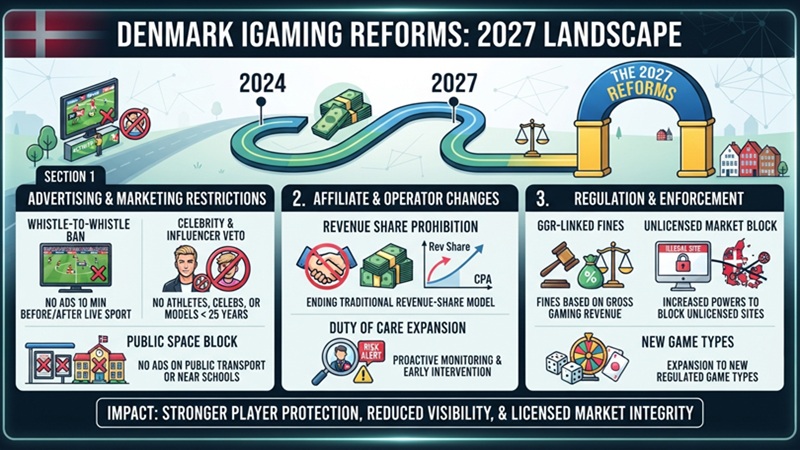
Restrictions on advertising around live sports. The proposal would prohibit gaming advertisements on television and streaming services in connection with live sports broadcasts, from 10 minutes before an event begins until 10 minutes after it ends. This would affect an important advertising channel for betting brands, particularly those that rely on sports coverage to reach adult audiences.
Limits on the use of public figures and younger people. The bill proposes restrictions on the use of authorities and people under the age of 25 in gaming advertising. Promotional content would also be prohibited from appealing particularly to children and young people. The measures aim to reduce the exposure of younger audiences to commercial gaming messages.
Greater accountability for affiliates and influencers. Under the proposal, responsibility for certain marketing violations would extend beyond licensed operators to other individuals and companies involved in promotion, including affiliates and influencers. The bill also proposes a ban on commission paid to partners on a turnover basis. This would change commercial arrangements for some affiliate programs by removing compensation structures linked directly to the amount of gaming activity generated.
Additional powers against unlicensed activity. The DGA would receive stronger supervisory tools to address unauthorized gaming promotion and improve enforcement against violations. The proposal includes provisions enabling authorities to block advertisements for certain unauthorized gaming products and strengthening the basis for sanctions.
The legislative package also proposes changes to land-based gaming. These include a new approval system for retailers, replacing the existing manager-approval model, and adjustments to the rules governing gaming arcades and gaming machines.
The bill sets January 1st, 2027, as its proposed general commencement date, although several provisions would take effect later. Certain measures are scheduled for July 1st, 2027, while many of the principal operational changes would apply from October 1st, 2027. Applications under the proposed retailer-approval system could be processed from April 1st, 2027, ahead of the planned October implementation.
Responsible play remains central to the regulatory agenda
The proposed reforms build on Denmark’s existing player-protection framework. The DGA administers ROFUS, the national register through which individuals can voluntarily exclude themselves from licensed gaming, and StopSpillet, a helpline offering guidance to people experiencing gaming-related problems.
Authority’s statistics page recorded 74,714 people registered with ROFUS as of September 1st, 2026. The register forms part of the country’s wider approach to identifying and reducing harm, alongside operator obligations and public information initiatives.
The political agreement of October 2025 places further emphasis on preventing gaming-related problems and strengthening protection for children and young people. The proposed advertising restrictions and expanded enforcement powers are intended to support these objectives.
For licensed operators, the changes would require a review of marketing strategies, media placements, influencer agreements and affiliate remuneration models. Businesses operating in the retail segment would also need to prepare for the proposed approval framework and its implementation timetable.
A mature market facing a new compliance phase
Denmark enters 2027 with an established licensing system, high digital participation, and online casino as its largest gaming category. Its next regulatory phase is less about opening the market to new forms of competition and more about defining the conditions under which operators can reach consumers and conduct business.
The final outcome of Bill L 37 will be important for operators, affiliates, suppliers, and retail partners. If the proposed measures are adopted, the staged implementation dates will give the industry a defined period to adjust its commercial and compliance practices.
For the wider European iGaming sector, Denmark offers a relevant example of how an established regulated market can revise its rules while retaining a licensed framework for private operators. The key question for 2027 will be how effectively the new requirements strengthen consumer protection and enforcement while preserving a sustainable environment for legitimate market participants.