








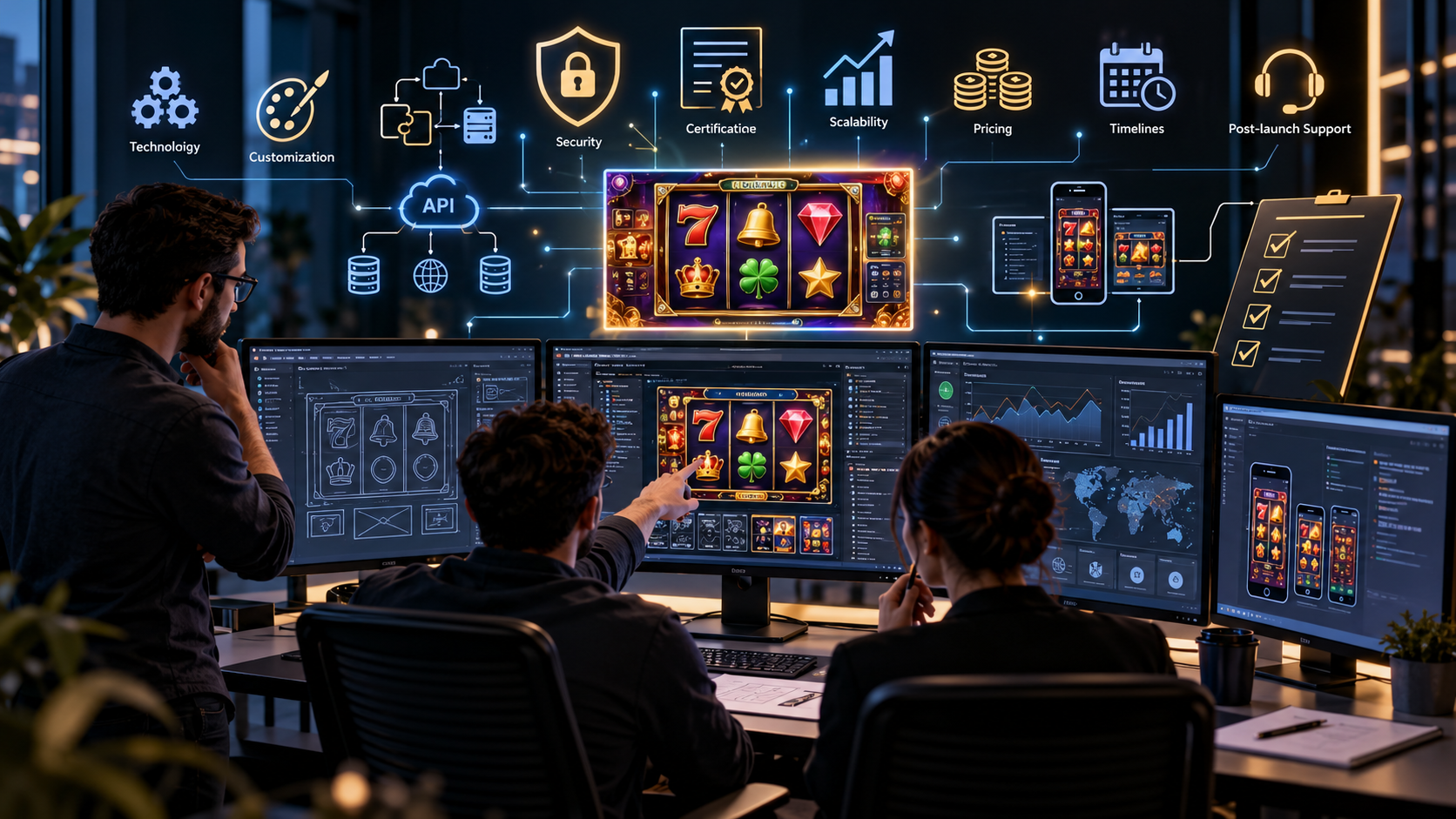
Finding out a casino game development company often begins long before development starts. The best fit in this market is one that supports your game requirements, technology, target markets, ownership expectations, and launch plan, not just your budget.
For operators, casino platforms and gaming businesses, the selection process should go beyond questions such as, ‘How many games have you developed?’, although a comprehensive portfolio may represent the technology and experience needed for a particular project.
Why choosing the right casino game development company matters
The choice of casino game development company will influence the game post-launch, not just during development. Operators must review some of the key areas before picking a partner.
- Game build: Ask how the development team approaches the core game logic, maths, RNG, testing, and development, rather than focusing on the project’s look and design.
- System security: Get clarity on how the game data, player sessions, APIs, and backend systems are being protected.
- Future growth: Whilst your first few casino titles may be a breeze with a smaller set-up, make sure the technology can sustain itself when the portfolio and traffic increase.
- Gameplay experience: Speed, mobile responsiveness, animations, and stable gameplay are all areas that matter once real-world traffic accesses the games.
- After launch: Understand who is handling any fixes, technical changes, updates, and technical integration issues once the title is live.
Before you choose a casino game development partner
Avoid choosing a partner on the portfolio alone. Instead, pay closer attention to the team’s technical set-up, the type of projects worked on, how it handles any integrations, and what happens after the game is live.
- Portfolio and experience
Consider the games built – custom slot game development, table games, fast games, or other formats can require different development skills.
- Technology and game infrastructure
Ask what is at the core of the game – the development stack, RNG, RGS, backend, APIs, and mobile compatibility can all be factors.
- Security and certification
Get clarity on the RNG testing, game security, data protection, and certification – these requirements are something to be discussed before development rather than post-launch.
- Integration
Review the ways the games will integrate with your existing platform, aggregator, PAM, wallet, or other systems – good API documentation and integration support can save a great deal of time.
- Custom development
Clarify what is meant by ‘custom’ – it could be the change in artwork and branding, or it could include mechanics, mathematics, RTP, UI, animations, and other areas.
- Future growth
Whilst your first launch may be a small affair, your portfolio may not always represent the same scale – check whether the developer can sustain itself once you add more titles and the traffic increases.
- Price, schedule and support
Know what the quoted price covers, when you can expect the delivery, and who is there post-launch. Understand how the fixes, updates, and technical issues will be handled.
Questions worth asking your casino game development partner
Before making a choice, go beyond the game concept and discuss the technology, customisation and integrations, timelines and support.
- Experience – Have you built games similar to ours, and can you provide relevant project examples?
Ensure the focus is on experience with game formats, target markets, platform requirements, and development model.
- Technology – What powers the games, and how is the technology built for casino operations?
This goes beyond the programming language – understanding the game engine, RGS, backend, APIs, performance capabilities, and security approach is essential.
- Development Cost – What does the quoted price cover, and what is not included?
Get clarity on design, mathematics, development, QA, certification, integration, source-code delivery, maintenance, and any recurring costs.
- Timeline – What happens between signing the contract and going live?
Ask for a stage-by-stage roadmap outlining the concept, design, development, testing, certification, integration, and deployment.
- Integrations – How will the games integrate with our existing casino ecosystem?
Confirm compatibility with your platform, PAM, Wallet, Aggregator, or other third-party systems, in addition to the level of technical support provided.
- Support – Who is handling the game once it is live?
The first thing is to understand the provider’s handling of bug fixes, game performance issues, compatibility changes, latest updates, and ongoing maintenance.
- Customization – How much of the game can we make our own?
Next, get clarity on whether you can customise the branding, game mechanics, math models, RTP, theme, artwork, animations, UI, and other game elements, or if customization is limited to the surface.
Why choose TIGGAMES for casino game development?
TIGGAMES, the best casino game development company, works with global operators that need more than just off-the-shelf casino games. Starting from developing titles around a specific game concept to supporting required integrations and technical work post-launch, the entire team supports all stages in growing their game portfolio.
- Casino Game Development Solutions – Develops slots, table, crash, dice, and other custom casino titles for different business requirements.
- Customization – Games can be tailored across mechanics, mathematics, RTP, themes, artwork, UI, animations, branding, and more.
- Technology & Integrations – Supports API and platform integrations with casino platforms, aggregators, wallets, PAMs, and other systems.
- Scalability – Built to support the growth in game portfolios, traffic, and expanding platform requirements.
- Support – Provides ongoing assistance with troubleshooting, updates, compatibility, and post-launch maintenance.
Red flags to watch for
When comparing development companies, certain gaps could raise further questions.
Be wary when a provider has:
- No verifiable examples of previous casino projects
- Source-code or IP ownership terms are unclear
- No defined certification process
- Development timelines are vague
- Little technical documentation is available
- Integration responsibilities are unclear
- Pricing is very low with an undefined scope
- No formal process is in place for post-launch support.
Whilst these issues do not necessarily disqualify a provider, they should be clarified before entering a development agreement.
Final checklist for choosing a casino game development company
Before making a decision, compare the shortlisted providers based on the same criteria:
- Game expertise – Does the company understand your specific game format?
- Technology – Can the company’s architecture support your platform and traffic requirements?
- Compliance – Does the company understand the certification and regulatory requirements for your target markets?
- Ownership – Are the source code, IP, artwork, and exclusivity terms clearly defined?
- Integration – Can the games integrate into your existing casino ecosystem?
- Commercial terms – Does the quotation clearly identify what is included?
- Delivery – Is there a defined development and launch process?
- Support – What happens after the game goes live?
Choosing the best casino game development company is not just about comparing quotes and counting the games in its portfolio. Look at the team’s development experience, technical set-up, scope for custom work, certification knowledge, integration support, ownership terms, scalability, and what they offer after the games go live.
For businesses looking to develop tailored casino games, TIGGAMES provides casino game development services across multiple game formats. Looking to build your next casino game? Get in touch with TIGGAMES to discuss your requirements.
FAQs
- How much does casino game development cost?
The budget can vary between one project and another. Whereas a standard game will have a different cost, a title built with original artwork, new mechanics, custom maths, platform integrations, and certification will be quite different. The easiest way to get a realistic estimate is to share the project scope with the development team.
- How long does development take?
There is no set turnaround for every game. Whereas a straightforward game can move through the development process more quickly, a custom game may need extra time on artwork, game mechanics, testing, integrations, and certification.
- What types of casino games can be developed?
It depends on the development company’s capabilities. Common projects include slots, table games, crash games, dice games, instant games, and other casino formats developed around a specific concept or brand.
- How do I choose a casino game development company?
Avoid deciding online and look at the games they have delivered, ask how they handle technical support, and discuss your business needs around customization, integrations, certification, cost, delivery, and support before committing.