








By Tatiana Martins, journalist at G&M News.
North America leads on scale
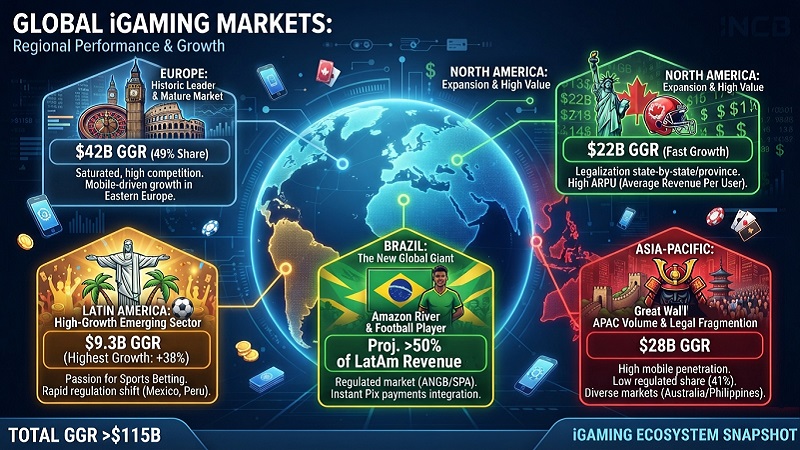
North America remains one of the most attractive betting regions because it combines size, premium customers and a still-developing competitive landscape. In the United States, the number of legalized states has continued to expand, while the market has matured enough for operators to focus more on product depth, retention, and profitability than on raw acquisition.
Canada is also drawing attention, with market forecasts pointing to strong growth and a high CAGR through 2030, reflecting the country’s combination of digital maturity and stable regulation.
The smart money is flowing toward operators that can scale efficiently in regulated environments, especially where payments, compliance and customer experience can be standardized across multiple provinces or states.
Europe stays the benchmark
Europe still represents the most mature betting region and remains a benchmark for product sophistication, though growth is now more selective. The continent continues to attract investment because of its established customer base, deep sports culture and advanced online betting infrastructure.
At the same time, the region is becoming more disciplined, with operators concentrating on markets that offer legal clarity, sustainable tax structures and manageable advertising rules. IBIA has argued that successful betting markets tend to combine strong integrity provisions, balanced advertising parameters and practical player protection, which helps explain why capital continues to favor well-regulated European jurisdictions.
This makes Europe less about explosive expansion and more about steady, high-quality returns for operators that can compete on brand, data and compliance.
Latin America gains strategic weight
Latin America represents one of the most important growth stories in global betting, with Brazil at the center of investor attention. The country’s regulated market is still in its early consolidation phase, but official data already suggests a large and fast-developing ecosystem, with more than 25 million unique bettors, around 100 million active accounts and estimated GGR of R$36.9 billion (USD 7.7 billion).
Brazil’s Regulatory Agenda for 2026-2027 has also made the market more legible for operators, laying out priorities such as authorization criteria, payments, anti-illegal betting measures, affiliate advertising and responsible gaming.
That combination of scale, formalization and long runway is exactly what investors are looking for. Across the region, the smart money is moving toward markets where regulation is becoming more predictable and where local payment habits, especially instant transfers, can support long-term user adoption.
Asia-Pacific keeps growing
Finally, Asia-Pacific continues to attract attention because of its population scale, mobile-first behavior and long-term digital growth potential. Forecasts point to the region as one of the fastest-growing areas in the global sports betting market, with particular momentum in mobile betting and digital engagement.
The opportunity here is not uniform, however. Investors are concentrating on markets with clearer legal frameworks or strong consumer demand that can eventually support regulated expansion. That makes Asia-Pacific attractive, but also more selective, with capital favoring operators that can navigate local rules, technology expectations and product localization.
The region’s future value lies in its ability to combine scale with frictionless mobile access, which is why product, language and payment adaptation matter so much.
Real winners are operational
What separates the most attractive betting markets today is not just growth potential, but operational clarity. Investors are prioritizing jurisdictions where licensing is achievable, payments are efficient, integrity standards are visible, and customer acquisition can turn into repeat value.
This is also why operators are placing more emphasis on in-play betting, personalization, AI-driven pricing, and responsible gaming tools. These features improve retention and make markets more resilient, especially when acquisition costs rise and regulation tightens.
In practice, the new global map of betting is less about where the loudest growth is happening and more about where growth can be defended over time. That is where the smartest capital is moving.