








Somewhere in the supplier listings of the online gambling industry, gamification has become a filing category of its own. It sits on the marketing shelf, next to loyalty programs and promotional tooling, as a service that specialist companies sell to operators the way other companies sell payment processing or identity checks. For anyone in engagement design that is a telling detail: the industry is large enough for the discipline to be a line item, and somewhere a buyer is working out which of a handful of firms to call.
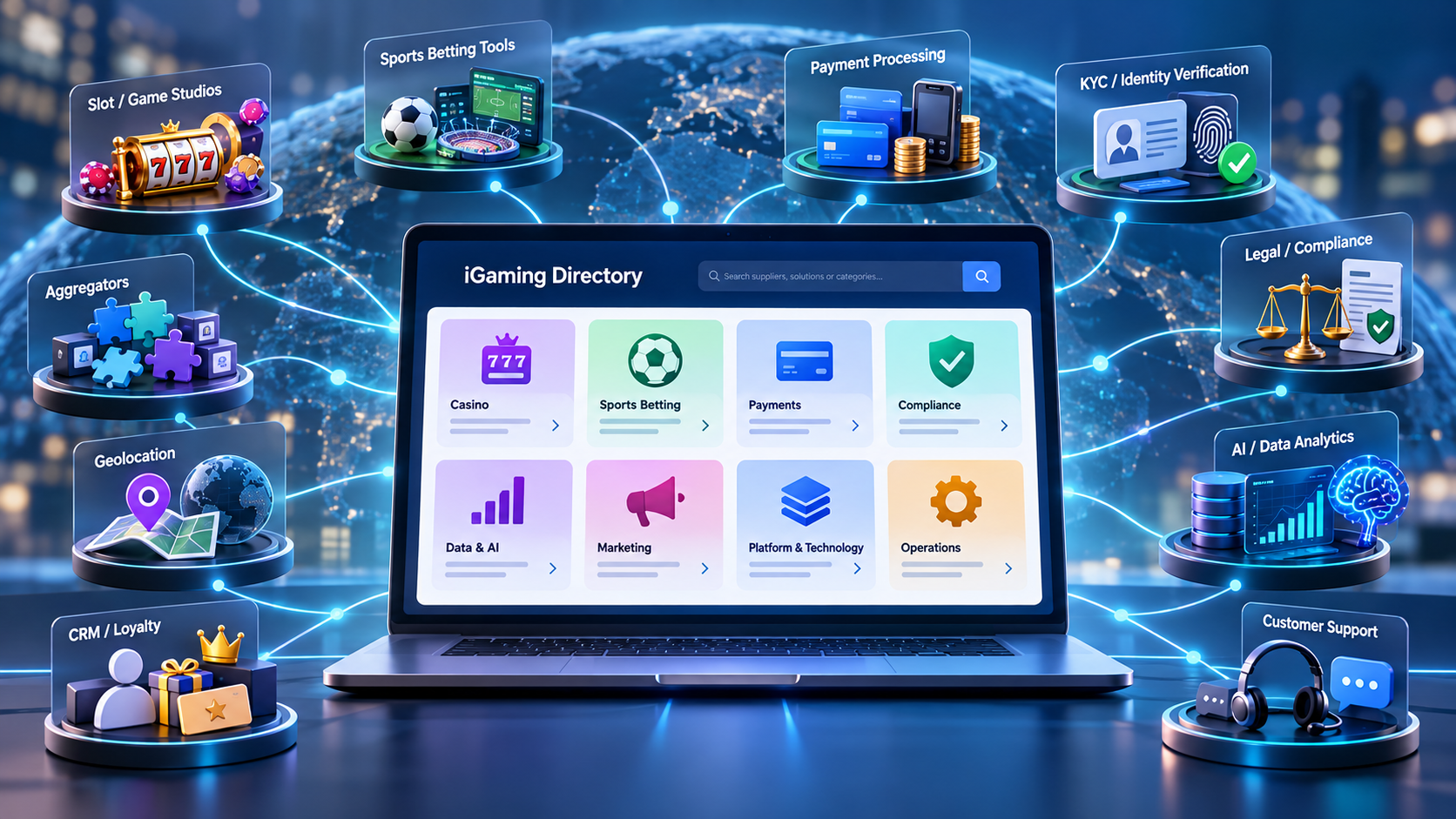
The online casino and sports betting business is no longer a matter of operators on one side and game providers on the other. Behind any gaming product there can be studios, aggregation platforms, payment infrastructure, compliance and testing specialists, data and AI vendors, marketing and affiliate services, support outsourcers and a long tail of technology companies. They share no single vocabulary that outsiders can follow, and a person still working out what they need has nowhere obvious to begin. Directories are one answer, because they give the market a structure that a search engine will not.
Why A Single Search Cannot Map The Industry
Search for “iGaming supplier” and every result is technically right, but the page as a whole tells you nothing. A studio in Stockholm that builds slot content, a payments orchestrator in Malta, a geolocation vendor in New Jersey and a Manila support outsourcer all describe themselves with the same two words. A business looking for content may need a studio or an aggregator; a business looking for a platform may need a full turnkey operation or a single API; a business looking for “compliance” may need a licensing consultant, a legal adviser, a responsible gambling toolset, a test laboratory or a geolocation service, and those are five different companies, each with its own price list.
Much of this fragmentation is regulatory in origin. Malta, one of Europe’s main licensing hubs for online gambling, issues a dedicated business-to-business license for suppliers whose software produces the records the regulator relies on. When a regulator defines a function, a category of company grows up to perform it. The practical consequence for a buyer is that the first question is never “which company?” but “which kind of company?”, and a flat list of names cannot answer it.
What Each Directory Is For
What Kind Of Company Do I Need?
Gamification is its own category on iGamingVoice, filed under marketing and affiliates next to retention and loyalty, bonus engines and CRM automation. That placement tells an engagement designer where the wider industry thinks the work belongs. The rest of the directory is sorted the same way. There are eight groups: casino, compliance, data and AI, marketing and affiliates, operations, payments, platform and technology, and sports betting. Each splits again into the specific jobs companies are hired to do, so a reader who does not yet know a casino platform from a game aggregator learns the difference from the table of contents. The directory is new, and its listings say what each company supplies, not how well.
How Large Is Each Part Of The Market?
iGaming Centre shows how big each part of the market is. It lists well over a thousand suppliers, and each main category shows a count, so a reader can see at once that game development is one of the most crowded corners of the industry while other categories hold a few dozen firms. The listings share the site with a calendar of industry events, a jobs board, a glossary and a set of licensing guides arranged by jurisdiction, which makes it as much a primer on the industry as a directory. A reader deciding whether a segment is worth entering can see the crowd before joining it.
Who Owns And Runs These Companies?
iGaming Directory, from Casino City Press, should not be read as a supplier list at all. It is a subscription research database whose subjects are the gaming sites themselves, ranked by traffic, the companies and executives behind them, the software houses and the individual games they publish, the payment processors, more than two hundred regulatory jurisdictions and a library of annual reports. The free tier opens a narrow window; the paid tiers open the rest. The question it answers is “who is behind this company, where is it regulated and what else does it own?”, and that becomes the pressing question once a shortlist exists.
Which Of These Few Should I Look At Closely?
iGamist keeps its scope deliberately narrow: four kinds of supplier, meaning game providers, B2B solutions, aggregators and payment systems, rather than a full taxonomy. Its effort goes into the profile. Each one passes an editor before publication, which is the sense in which its providers are “reviewed”, and a reader can line a handful up against one another on the page. It does not publish user ratings and should not be expected to; its use is in examining a few candidates in parallel once the broad search is done.
Where Does Online Gaming Meet Everything Else?
The World Gaming Directory, published by iGB and powered by Clarion Gaming, the organizer of ICE, draws its boundaries by sector rather than by function. Online gaming is one section among several; casino floors, tribal gaming, esports and payments each have their own, and the whole is woven into iGB’s reporting and Clarion’s exhibitions. A reader who needs to see how the online supply chain connects to physical casinos, to tribal operators in the United States or to esports betting will find those links drawn here.
Where Due Diligence Begins
A directory entry records that a company exists and claims a function, and the claim is the company’s own. Everything a buyer needs to know next, from whether the company may legally supply a given market to whether its technology will fit and its terms will hold, comes from the regulator’s public register, the integration documentation, reference customers and the contract itself. The directory gets a buyer to a shortlist. Deciding who gets the contract is due diligence, which is a different job and usually somebody else’s.
For a gamification vendor in particular, the test of suitability is the test the discipline applies to itself: whether a mechanic can be tied to a measurable outcome before it is built. A listing cannot show that; a pilot can.
Structure First
The complexity of iGaming comes from specialization, and it is not going to reverse. More kinds of companies now build, operate, support and market gaming products than ever, and finding the right part of that ecosystem has become a task in itself. A directory does not make the market smaller. It puts names on the parts, which is what a buyer needs before anything else can happen.