








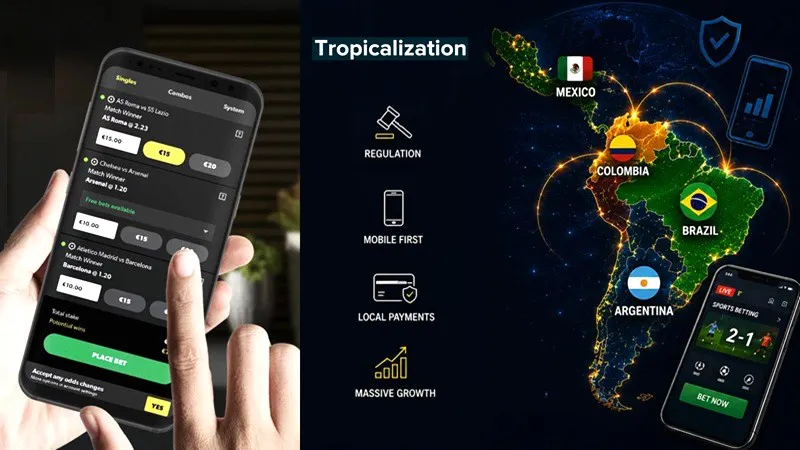
Generally, Latin America is described as one of the most promising regions for the global iGaming industry. I agree with that assessment but, based on my experience working with companies interested in expanding across the region, I have learned that LatAm cannot be approached as a single commercial market.
Geographically, it is one region. Commercially, however, it is a collection of very different countries, each with its own regulatory environment, player behavior, payment preferences, technology requirements, taxation, acquisition channels, and business culture.
One of the most common mistakes I see is that international companies arrive with a “LatAm strategy” when what they really need is one strategy for Brazil, another for Mexico, another for Colombia, and so on.
Language is only the most visible difference. The real challenge is understanding how each market operates and adapting the entire business around that reality.
That is why I believe tropicalization -not simple translation- is the key to sustainable growth in Latin America.
LATAM HAS AWAKENED
My professional experience in Europe gave me the opportunity to work around more mature and competitive gaming markets. In those environments, players already expected high standards throughout the entire journey, from registration and game selection to payments, customer service and withdrawals.
A few years ago, much of Latin America was in a different stage of development. In many markets, there was not yet enough competition to push the industry toward a consistently higher level. Players had fewer alternatives, and the quality of the platform, content and overall experience was not always the deciding factor it is today.
That reality is changing quickly, and I have seen this evolution firsthand. Latin America has awakened. Players are more informed, more digital and increasingly aware of what a high-quality gaming experience should look like. They compare products, recognize strong content and expect services that are fast, intuitive and trustworthy.
The Latin American player is no longer satisfied simply because an online gaming product is available. Players increasingly demand better technology, relevant games, competitive odds, fast payments, reliable withdrawals, and professional customer support.
For operators and suppliers, this evolution raises the standard. Competition is no longer only about entering the market. It is about earning the player’s trust and delivering an experience strong enough to retain it.
KEY MARKETS TELL DIFFERENT STORIES
Brazil naturally attracts attention because of its size, digital adoption, and regulated betting environment. I see it as a market with the potential to become one of the world’s most important regulated jurisdictions, but its size also brings complexity.
Operators must understand local regulation, responsible gaming requirements, player verification, and a payment ecosystem in which PIX has completely transformed consumer expectations. Brazilian players are used to instant transactions. In my experience, a platform can offer an excellent gaming experience, but if it creates friction during deposits or withdrawals, it will struggle to retain customers.
Mexico presents a different opportunity. It combines scale, a strong gaming culture and considerable long-term potential, but it operates under an older regulatory structure. Entering this market requires a practical understanding of local permits, commercial relationships and the realities of operating within the existing framework.
Colombia remains one of the region’s most important reference points. Its regulated online model gave the industry an early example of how licensing, local oversight and operator participation could work in Latin America. It is also a competitive and increasingly mature market. From my perspective, a recognizable international brand is no longer enough. Operators need a differentiated proposition, relevant content and strong local experience.
Peru has become another key regulated jurisdiction. Its framework creates greater clarity for operators and technology suppliers, while also raising expectations regarding authorization, certification and compliance. I would not approach Peru as a smaller version of Colombia. Its customers, payment environment and commercial dynamics require their own strategy.
Argentina is fundamentally different because it cannot be approached as a single national market. Its provincial structure makes regulation and market access more fragmented. Buenos Aires Province and the City of Buenos Aires, for example, are separate jurisdictions. Understanding this structure is essential before making decisions about technology, partnerships or investment. In my experience, overlooking this point can create unnecessary complexity from the very beginning.
Chile presents a different challenge because its online gaming regulatory situation remains unresolved. The market has sophisticated digital consumers and clear commercial potential, but the absence of a definitive regulated framework creates uncertainty for operators, suppliers, payment companies and players.
A regulatory proposal continues to move through the legislative process, while the current official position is that commercial online betting platforms operate without legal authorization. Until that gap is resolved, companies must evaluate Chile with particular caution. Market demand exists, but demand alone cannot replace regulatory clarity, consumer protection, and plain operating rules.
Paraguay, Ecuador and Uruguay are smaller markets, but I do not believe they should be ignored. Each offers distinct opportunities shaped by its regulatory environment, payment infrastructure, consumer behavior, and market scale. They require focused evaluation rather than being treated as extensions of larger neighboring markets.
Central America and the Caribbean should not be overlooked either. Markets such as Panama, Costa Rica, the Dominican Republic, and Guatemala can offer valuable opportunities, but each has a different combination of regulation, tourism, banking infrastructure, consumer behavior and market size. Smaller does not mean simpler. In many cases, it means that local knowledge becomes even more important.
PLATFORMS SHOULD BE FLEXIBLE BY DESIGN
The gaming platform is the foundation of any operation, but in LatAm, it cannot be rigid. From my perspective, a platform must be able to accommodate different registration processes, currencies, tax treatments, reporting obligations, responsible gaming tools, and integrations. It should also perform well across a wide range of devices and connection speeds.
Mobile-first is essential, but that phrase means more than fitting a website onto a smaller screen. Registration, deposits, game discovery, betting, and withdrawals must all feel intuitive on mobile devices.
The back office must be equally adaptable. Operators need to segment customers by country, understand local behavior and manage promotions without applying the same rules everywhere. A welcome offer that works well in one market may be commercially weak -or even inappropriate- in another.
Choosing a platform for LatAm is therefore not simply a technical decision. It is a market-entry decision. Technology must support the business strategy, not force every country into the same operating model.
THE GAME PORTFOLIO MUST FEEL LOCAL
Content is another area where I often see companies overgeneralize. Players across the region may share an interest in football, slots and live casino, but their preferences are not identical. Game mechanics, volatility, themes, bet sizes, and even the pace of play can perform differently by country and customer segment.
The strongest strategy combines proven international content with a carefully selected local portfolio. Operators and aggregators should study real player data and continuously refine the lobby instead of assuming that globally popular games will automatically lead the rankings in every market.
Localization also includes presentation. Spanish cannot be treated as one universal version, and Brazilian Portuguese requires more than a direct translation. Terminology, promotional messages and customer communication should sound natural to the player. If the language feels artificial, the entire product can feel distant, even when the technology is strong.
Game providers that understand these differences can become genuine growth partners. Those that simply deliver a catalogue risk becoming interchangeable.
PAYMENTS ARE PART OF THE PRODUCT
In my view, payments are one of the most underestimated elements of an iGaming expansion strategy. The cashier is not a separate technical function. It is a central part of customer experience and one of the strongest drivers of conversion, trust and retention.
Every market has its preferred methods. Brazil has PIX. Colombia has an ecosystem that includes bank transfers, cards and cash-based alternatives. Mexico has its own combination of cards, bank transfers and cash payment networks. Elsewhere, wallets and alternative methods can be decisive. Local payment providers contribute more than a connection to a payment method. They understand approval rates, settlement, fraud patterns, user expectations, and the operational realities of their market.
Fast deposits attract customers, but reliable withdrawals build trust. I always encourage operators to evaluate payment partners based on the complete transaction journey, not only the cost per transaction. A payment solution that looks efficient on paper but creates delays, failed transactions or uncertainty during withdrawals can damage the entire brand experience.
THE REAL COMPETITIVE ADVANTAGE IS LOCAL INTELLIGENCE
Technology can be purchased. Games can be integrated. Payment methods can be connected. What is much harder to replicate is local intelligence. Successful expansion requires the right combination of regulatory understanding, technology, content, payments, marketing and trusted relationships. These elements must be considered together from the beginning, not added one by one after the launch strategy has already been defined.
This is also where experienced local partners create real value. They can help international companies identify the right opportunities, avoid unsuitable partnerships and understand how business is actually conducted in each jurisdiction.
Throughout my experience, I have seen that companies with the strongest results are not necessarily those with the biggest budgets. They are the ones that listen to the market, adapt quickly, and surround themselves with people who understand the local reality. The greatest opportunity in Latin America belongs to companies that can combine international standards with local execution.
My professional vision is straightforward: think regionally but build country by country. Tropicalization is not a final adjustment made before launch. It is not simply translating a website, adding a local payment method or changing a few promotional messages. Tropicalization is the strategy itself.