








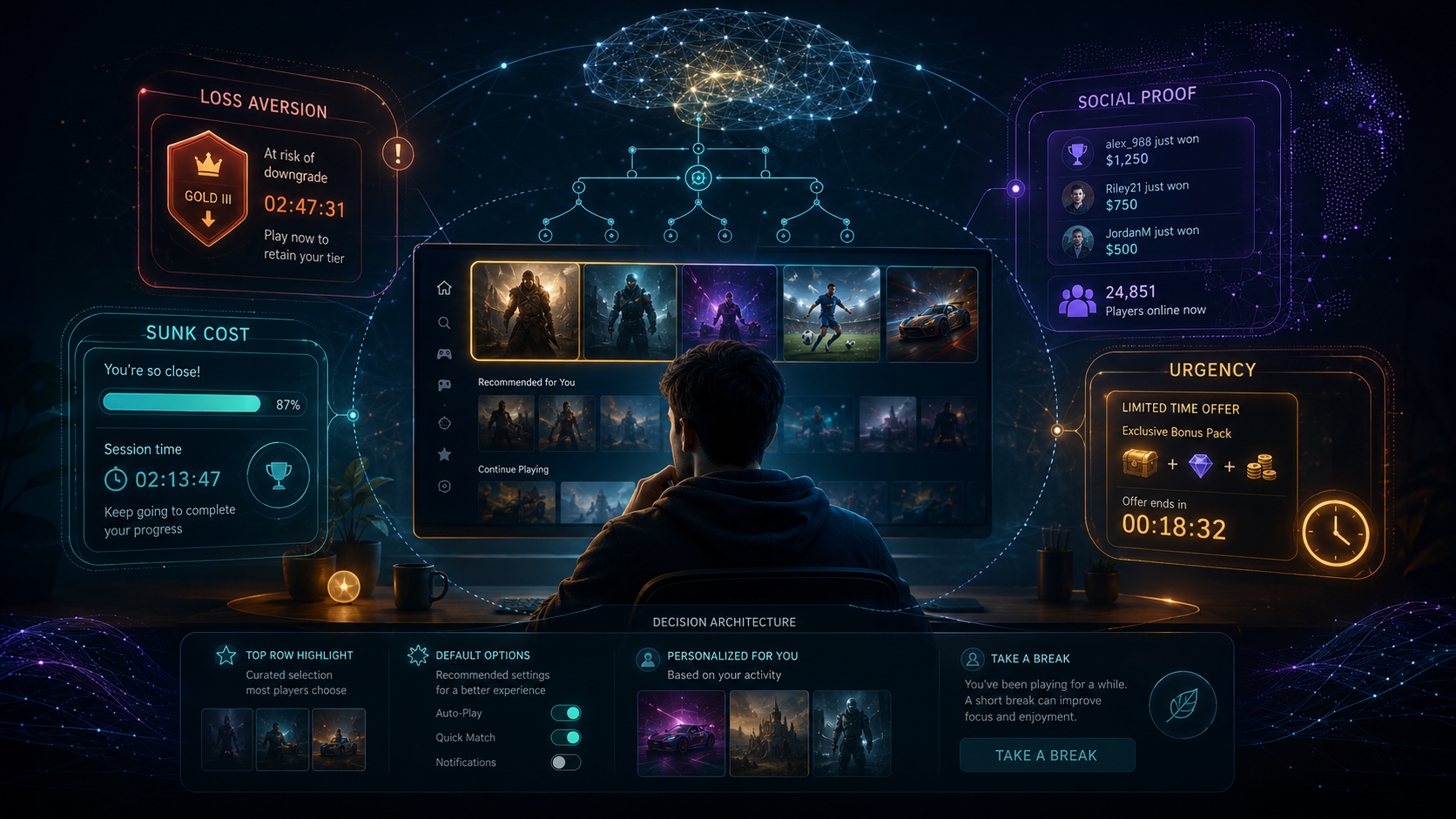
Key Psychological Drivers in Digital Entertainment
Research across behavioral science and iGaming-specific studies identifies a consistent set of psychological drivers that influence engagement, spending, and retention decisions at the platform level.
| Psychological Driver | How It Manifests in Player Behavior | Platform Design Implication |
| Loss aversion | Players work harder to avoid losing a bonus or status than to gain an equivalent reward | Expiring rewards and tier demotion warnings increase engagement more than equivalent gain-framed incentives |
| Sunk cost fallacy | Players continue sessions beyond their intended duration due to prior time or money investment | Session transparency tools help operators meet responsible gambling obligations while maintaining trust |
| Social proof | Players are more likely to try a game or accept an offer if they see evidence that others have done so | Recent winner displays, popularity indicators, and community activity feeds reinforce platform engagement |
| Scarcity and urgency | Time-limited offers and exclusive access trigger faster decision-making and higher conversion rates | Countdown timers and limited availability signals in promotional design improve offer uptake |
Decision Architecture and Platform Design
The concept of decision architecture, the deliberate structuring of choices to influence outcomes, has moved from academic behavioral economics into mainstream product strategy. In digital entertainment, every screen layout, every default setting, and every notification is a decision architecture choice with measurable behavioral consequences.
Default Settings as Behavioral Levers
Research consistently shows that users disproportionately stick with default options, regardless of whether those defaults serve their interests. Operators can apply this insight constructively by setting responsible defaults around session duration notifications, deposit limit suggestions during onboarding, and communication frequency preferences.
Choice Architecture in Game Lobbies
The order and prominence with which games are displayed in a platform lobby directly influences which titles receive the most engagement. Players are significantly more likely to select games positioned in the top row or highlighted sections of a lobby, an effect that holds even when users report that they chose based on personal preference.
Emotional States and Spending Behavior
Emotional context at the time of a decision has a well-documented effect on risk appetite and spending behavior in digital entertainment environments. Players in elevated emotional states, whether positive or negative, tend to make faster decisions with less deliberation and are more responsive to time-sensitive offers.
| Emotional State | Observed Behavioral Pattern | Average Session Impact |
| Excitement after a win | Higher risk tolerance and increased bet sizing in subsequent rounds | +34% average bet increase in the three rounds following a significant win |
| Frustration after a loss | Faster session re-entry and reduced deliberation time before next action | -41% average decision time compared to neutral session baseline |
| Boredom or routine state | Increased responsiveness to novelty signals and new game recommendations | +28% click-through rate on new title promotions during low-engagement sessions |
| Calm and deliberate state | Higher engagement with responsible gambling tools and account management features | +52% interaction rate with deposit limit and session review prompts |
How Operators Are Applying Behavioral Insights
Fireball Casino applies behavioral insight across both its product design and its player communication strategy, using session data and engagement patterns to determine the optimal timing and format of messages, offers, and responsible gambling interventions rather than relying on broadcast scheduling that ignores individual player context.
Timing as a Psychological Variable
The moment at which a communication or offer reaches a player is as important as its content. Behavioral data shows that players are significantly more receptive to retention offers immediately after a session ends than during an active session, a pattern that has measurable implications for CRM strategy across the industry.
Personalization and Psychological Relevance
Generic communications that ignore individual player history are not just less effective than personalized ones. They actively signal to players that the platform does not understand them, which has a measurable negative effect on brand perception and long-term engagement scores.
Measuring the Impact of Behavioral Design Decisions
Operators committed to evidence-based product development track a consistent set of behavioral metrics that reflect the quality and effectiveness of their psychological design choices across the player journey.
| Design Decision | Behavioral Metric Tracked | Reported Performance Range |
| Loss-framed loyalty tier warnings | Tier retention rate month-over-month | 15% to 23% improvement versus gain-framed equivalent |
| Post-session CRM timing | Offer acceptance rate within 24 hours of last session | 2.1x to 3.4x higher than mid-session delivery |
| Personalized game recommendations | Click-through and first-session completion rate | 18% to 31% higher than lobby-default positioning |
| Responsible gambling default prompts | Interaction rate with session review and limit tools | 40% to 55% higher when placed at natural session break points |
Conclusion
The psychology of decision-making is not a peripheral consideration in digital entertainment product strategy. It is the underlying layer through which every design choice, communication, and platform mechanic either works with or against the natural tendencies of the human mind. Operators who build their product and marketing decisions on a foundation of behavioral understanding will consistently outperform those treating player psychology as a secondary variable.