







By Tatiana Martins, journalist at G&M News.
The 2026 FIFA World Cup is becoming a defining moment not only for football, but also for the wider evolution of sports engagement. Across the tournament, prediction markets and sportsbooks are giving fans new ways to follow matches, test their instincts, and stay connected to the action in real time.
A broader way to follow the tournament
For decades, betting has been one of the commercial engines behind major sporting events. At World Cup 2026, that engine is being reinforced by prediction markets, which allow users to trade or make forecasts on outcomes as probabilities shift through the tournament.
That model fits the structure of this World Cup especially well. With 48 national teams and 104 matches across the United States, Mexico, and Canada, the tournament generates a constant flow of information capable of moving sentiment and pricing from one game to the next.
ADI Predictstreet brings prediction markets into the mainstream
One of the clearest signs of the sector’s growing relevance is FIFA’s partnership with ADI Predictstreet. FIFA named ADI Predictstreet its Official Prediction Market Partner for the 2026 World Cup, marking a notable step in bringing forecasting products closer to the center of the tournament’s fan experience.
The commercial rollout has also been ambitious. DAZN announced the launch of ADI Predictstreet as a free-to-play prediction market experience for the World Cup, positioning the product as an interactive layer built around live participation, rankings, and fan involvement rather than a purely transactional betting tool.
That distinction matters. By presenting prediction markets as part of the digital viewing experience, the World Cup is helping introduce the format to a much broader audience, including fans who may be curious about forecasting but are not traditional sportsbook bettors.
Growth signals across the market
The commercial momentum around the category has been hard to ignore in June. Reporting this month indicated that World Cup-related prediction market activity had already surpassed USD 2 billion, underlining how quickly the format has scaled around the tournament.
At the same time, Kalshi’s World Cup-driven activity has been cited as a major force behind record trading performance, reinforcing the idea that football’s biggest event can act as a catalyst for both user growth and market liquidity.
These figures are significant because they suggest that prediction markets are moving beyond novelty status. Around the World Cup, they are increasingly functioning as a real-time barometer of fan conviction, crowd sentiment, and market confidence.
Sportsbooks remain at the center of the betting economy
The rise of prediction markets does not diminish the role of traditional sportsbooks. Licensed operators still offer the broadest range of pre-match and in-play products, along with local regulatory familiarity, marketing scale, and established customer habits.
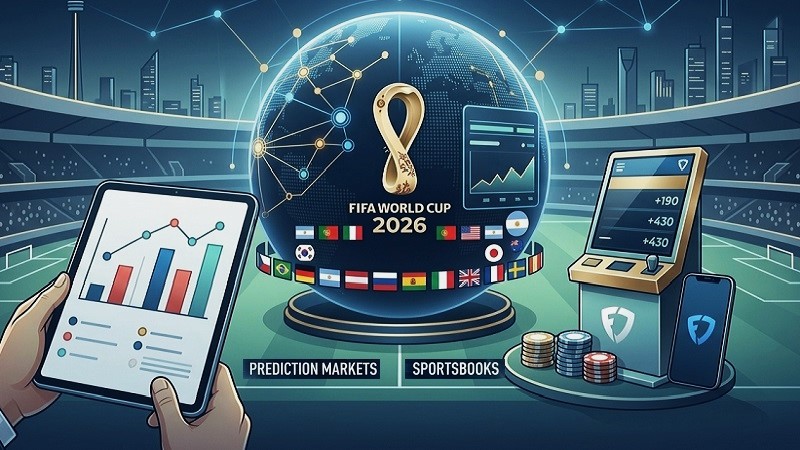
In practice, the two models can complement one another. Sportsbooks continue to serve users looking for conventional betting products, while prediction markets appeal to fans who prefer a more fluid, market-based way to express a view on matches, teams, and tournament outcomes.
For the industry, that coexistence is a positive sign. It points to a more diversified World Cup wagering ecosystem, where multiple formats can expand total engagement rather than simply compete for the same fixed audience.
Regulation is shaping the next phase
The growth of prediction markets has naturally drawn regulatory attention. In June 2026, the Commodity Futures Trading Commission (CFTC) published a proposal concerning public interest determinations for prediction markets and also issued an advisory on event contracts, highlighting the importance of oversight as the category expands.
Even so, increased scrutiny can also be read as a marker of maturity. As these products become more visible during globally significant events such as the World Cup, clearer rules and more formal supervisory standards can strengthen long-term confidence among consumers, partners, and sports stakeholders.
Integrity remains part of that conversation as well. FIFA’s integrity planning for World Cup 2026 has reflected the need to monitor betting-related risks across a changing market landscape, a sign that the governing body is treating innovation and oversight as parallel priorities rather than opposing forces.
A commercial opportunity beyond the pitch
The World Cup has always been a stage for new commercial models, and 2026 is showing how prediction products can join that tradition. For media companies, platforms, and sports properties, these tools create additional inventory for fan activation, retention, and second-screen engagement.
That is why the current cycle feels important. Sportsbooks still anchor the core betting economy, but prediction markets are proving that they can add freshness, transparency, and interactivity to the way global audiences follow football’s biggest event.
As a result, the 2026 World Cup may be remembered for helping normalize a broader and more participatory betting and forecasting culture. From FIFA and DAZN to ADI Predictstreet and established operators, the tournament is giving the industry a high-visibility platform to show how innovation can deepen fan engagement in a positive way.