








By Tatiana Martins, journalist at G&M News.
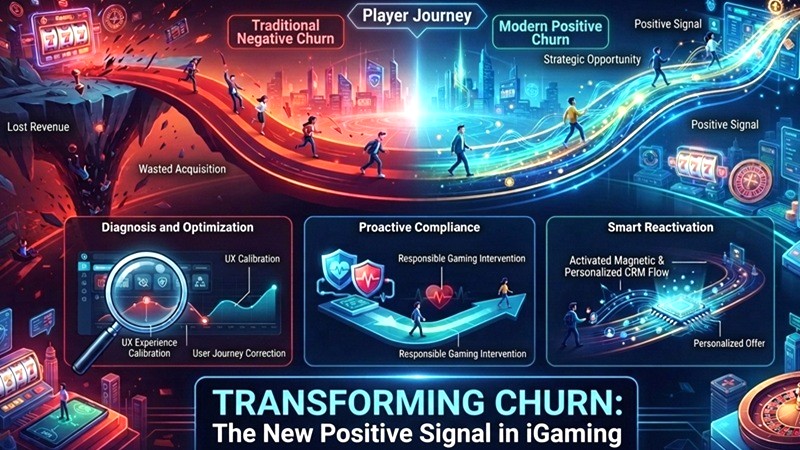
For years, churn was treated as a simple loss metric in iGaming. A sign that players had left and revenue had gone with them. In 2026, that view looks increasingly incomplete. Across the global market, operators are starting to read churn differently: as a measure of how well the product, the brand, and the player relationship are actually working.
That shift says a great deal about where the industry is heading. The sector is moving away from pure acquisition logic and toward a more disciplined model built around retention, trust, and sustainable lifetime value. In that environment, lower churn is no longer just good news for CRM teams. It is becoming a broader signal that the iGaming product itself has matured.
Retention is becoming a core benchmark
Recent benchmark data helps explain why this conversation matters now. Optimove’s May 2026 iGaming Pulse reported global active customer retention at 73%, in line with its trailing average, while U.S. retention had dipped to 64% in March 2026 after recovering to near 70% earlier in the year. The same research is built on a very large sample, tracking millions of active players in the U.S. and tens of millions globally, which gives operators a useful benchmark for how sticky their products really are.
Those figures matter because retention is more than a marketing KPI. In practice, it captures whether the user experience is smooth, whether the content mix is relevant, whether payment flows work, and whether the player feels confident enough to keep returning. When retention holds up in a more regulated and more competitive environment, it usually points to operational quality rather than luck.
Churn now reflects product quality
This is why churn is increasingly being discussed as a product signal. If players leave quickly, the problem may not be the audience itself; it may be friction in onboarding, weak user journeys, poor bonus design, low trust in withdrawals, or a failure to make the experience feel intuitive after the first deposit.
The most effective operators are responding by treating churn as feedback. Rather than simply increasing acquisition spend to replace lost users, they are using behavioral analytics, lifecycle CRM and better UX design to understand where player drop-off begins and what keeps engagement alive over time. That marks an important change in mindset: growth is becoming less about constant replacement and more about keeping a good product healthy.
Trust is becoming part of the product
One reason this matters more in 2026 is that trust has become a central feature of the iGaming experience. The latest SOFTSWISS 2026 iGaming Trends analysis argues that brand reputation, trust and structured compliance are playing a larger role than bonuses in acquisition and long-term competitiveness, while responsible gambling tools and cybersecurity are increasingly tied to retention.
That is a meaningful shift. A few years ago, many operators still competed primarily on promotions and speed of entry. Today, more are being judged on the reliability of the experience after sign-up: how transparent they are, how clearly they communicate, how safe the platform feels, and how responsibly they handle player behavior. The stronger those fundamentals become, the less churn looks like an unavoidable cost of doing business.
Responsible gaming is reinforcing retention
Another reason churn is taking on a more positive meaning is the growing role of responsible gaming. AI-based player protection tools, real-time risk monitoring and compliance-led design are becoming standard expectations in regulated markets, while responsible gambling is moving from a regulatory checkbox to a core part of the operating model.
That change supports retention in two ways. First, it helps operators build safer and more credible environments, which strengthens brand trust. Second, it encourages longer-term thinking: operators are more focused on sustaining player relationships without creating avoidable harm. In business terms, that is a healthier base for lifetime value.
Industry is getting better at early intervention
The technology stack behind retention has also become more sophisticated. Optimove’s churn research has shown that reactivation is highly time-sensitive, with day-one intervention carrying the highest value when trying to win back churned players. That kind of finding is pushing operators to invest in faster segmentation, more precise lifecycle messaging and earlier identification of churn risk.
This is where churn becomes constructive. Instead of being read only at the end of the player journey, it is now used as an early warning system. Operators can detect weaker engagement patterns, intervene sooner and improve outcomes without relying entirely on blunt promotional pressure. That is a sign of a more advanced commercial model, one that prizes relevance over noise.
A maturity signal, not just a warning sign
Evidence from across the sector suggests that iGaming is entering a more mature phase. The SOFTSWISS 2026 report describes an industry moving from rapid expansion into a cycle defined by operational efficiency, regulatory discipline and long-term sustainability. In that environment, churn is no longer just a negative outcome to be minimized at any cost; it is also one of the clearest indicators of whether those structural improvements are working.
Seen this way, lower churn is a sign that operators are building better products, stronger brands and more stable player relationships. For a sector that has spent years chasing scale, that may be one of the most encouraging developments of all.