







By Tatiana Martins, journalist at G&M News
Currently, player data is part of an increasingly complex iGaming business structure. Operators, platforms, affiliates, payment providers, CRM specialists, game studios and technology companies can all contribute to the player journey, but each company interacts with data for a different purpose. The challenge for the industry is building a clear framework for how data can be shared, processed, and activated across this network.
This is turning data governance into a strategic issue for the gambling sector. For operators, better data management can support customer acquisition, CRM, fraud prevention, payments and responsible gambling. For B2B suppliers, it creates opportunities to build more specialized products while giving operators greater control over how their technology infrastructure works together.
The debate around who “owns” player data, therefore, is becoming less about ownership in the traditional sense and more about control, access, responsibility and value creation.
Operator remains central, but the ecosystem is expanding
The operator generally has the most direct relationship with the player. It manages the gambling account, handles deposits and withdrawals, conducts identity verification and is responsible for complying with the rules of the market in which it operates.
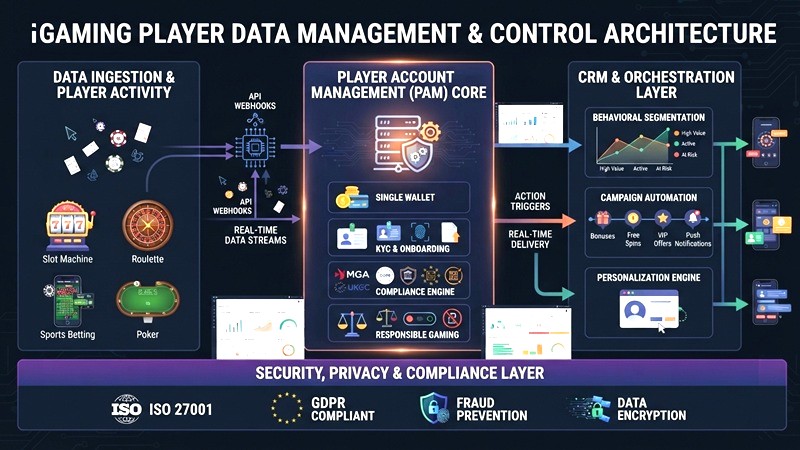
That makes the operator a central decision-maker when it comes to player information. At the same time, the modern gambling operation rarely runs on a single technology stack. Player information can pass between a platform provider, CRM system, payment service, fraud-prevention solution, KYC supplier, game provider and analytics platform during a single customer journey.
This is where the B2B ecosystem has an important role to play. The expansion of specialized technology has allowed operators to build more sophisticated businesses without developing every component internally. A sportsbook can work with one supplier for its PAM, another for payments, another for CRM and another for fraud detection. Each supplier can bring a specific capability to the operation, while data connects those capabilities.
From a regulatory perspective, the distinction between these companies matters. Under the GDPR, the organization that determines the purposes and means of processing personal data is generally considered the controller, while a processor handles data on behalf of the controller. Brazil’s LGPD adopts a similar framework through its definitions of controller and operator.
For B2B companies, this distinction provides a useful foundation for building technology partnerships. A clear understanding of responsibilities allows suppliers to develop products around specific operational needs without creating uncertainty about how customer information can be processed.
Data access is becoming a competitive advantage
The value of player data is not limited to knowing who made a deposit yesterday. When properly structured, it can help operators understand the complete customer lifecycle, from acquisition and onboarding to engagement, payments, retention and responsible-gambling interventions.
This is where the quality of the technology infrastructure becomes important. A CRM provider, for example, can help an operator connect information from different customer touchpoints and turn it into useful segmentation. Payment technology can contribute with transaction and fraud signals. Analytics platforms can help identify behavioral patterns. Affiliate technology can improve attribution and provide a clearer picture of acquisition performance.
The commercial opportunity comes from connecting these capabilities without losing control of the underlying data. For operators, this can mean better customer journeys and more efficient marketing. For suppliers, it creates demand for technology that can integrate with existing systems rather than requiring operators to replace their entire infrastructure. The result is a B2B market in which interoperability is becoming as important as individual product functionality.
Affiliates are part of the data conversation
Affiliates occupy an interesting position because they can interact with prospective players before those users reach an operator’s platform. A comparison website, content publisher or affiliate network may collect information about how visitors interact with its own properties. Once a user registers with an operator, however, the nature of the relationship changes. The operator becomes responsible for the data associated with the gambling account, while the affiliate may continue to have its own responsibilities for information collected through its website or marketing activity.
This does not need to create friction between the two sides. In a mature affiliate market, clearer data responsibilities can actually strengthen commercial relationships. Better attribution, more transparent reporting and well-defined data-sharing arrangements can give affiliates a clearer understanding of campaign performance while allowing operators to maintain control over their customer relationships.
The opportunity for B2B suppliers is to build the infrastructure that makes this exchange more efficient. Tracking, attribution and reporting tools can help both sides understand the commercial contribution of an acquisition channel without requiring unrestricted access to the operator’s customer database.
Payment technology is adding another layer of intelligence
Payments have also become much more than a mechanism for moving money between a player and an operator. Payment providers are involved in identity verification, fraud prevention, transaction monitoring and the optimization of customer experience. This gives them access to information that can be valuable for the wider operation, although the purposes for which that information can be processed depend on the specific relationship and applicable regulations.
For operators, this creates an opportunity to treat payments as part of the broader player journey rather than as an isolated back-office function. A smoother payment experience can reduce friction during registration and deposits. Better fraud tools can protect the operator and its customers. More sophisticated transaction analysis can support risk management.
The B2B opportunity is significant: payment companies can develop specialized services while operators benefit from technology that connects financial data with other parts of the operation under appropriate governance frameworks.
CRM is where data becomes actionable
If the operator’s platform is the center of the player account, CRM is often where the commercial value of that information becomes visible.
Modern CRM systems can connect player activity with segmentation, campaign history, preferences and engagement patterns. This gives operators the ability to create more relevant communications instead of treating every customer as part of the same audience. The regulatory framework establishes the conditions under which it can take place.
The GDPR, for example, requires organizations to have a lawful basis for processing personal data and places requirements around transparency, purpose limitation and individual rights. The LGPD establishes similar principles in Brazil.
For CRM providers, this creates a clear product-development opportunity. The strongest solutions will increasingly combine personalization with governance, giving operators the tools to understand why a particular data point is being used, where it came from and which permissions apply to the communication that follows. That is relevant in gambling, where customer engagement needs to coexist with responsible-gambling requirements.
The next step is better collaboration between B2B partners
The industry’s data challenge is also an opportunity to improve the relationship between operators and suppliers. Technology contracts can establish clear rules around access, processing, security, retention, subcontractors and what happens when a commercial relationship ends.
Data maps can show where information moves across the technology stack. APIs can make integrations more efficient. Standardized processes can reduce the amount of manual work required to transfer information between systems. These developments benefit both sides.
Operators gain greater visibility and flexibility across their technology infrastructure, while suppliers can create products that integrate more easily with multiple platforms and operating models. Instead of every company building isolated databases, the market can move towards connected systems in which each participant has a defined role.
This is important as regulated markets become more sophisticated. Brazil, for example, has created a framework in which licensed operators must meet requirements around areas such as customer identification, payments, advertising and responsible gambling.
Ownership may be the wrong question
Player data will remain one of the most important assets in online gambling but describing it simply as something that one company “owns” does not reflect how the modern industry works.
An operator may control the customer relationship. A platform may process the information required to run the account. A CRM provider may transform that information into segmentation and campaigns. A payment provider may process transaction data. An affiliate may provide acquisition and attribution information. Each company contributes to the player journey, but their rights and responsibilities are not necessarily the same. That complexity is a reflection of how specialized the industry has become.
The opportunity now is to make those relationships more transparent and efficient. Clear contracts, strong data governance, interoperable technology, and responsible use of customer information can allow operators and suppliers to extract more value from data while respecting the rights of the people behind it.
For the B2B gambling sector, the future of player data lies in building an infrastructure that allows the right companies to access the right information for the right purpose, under clearly defined rules. That is a much more relevant question for an industry that is becoming more connected every year.