








By Tatiana Martins, journalist at G&M News.
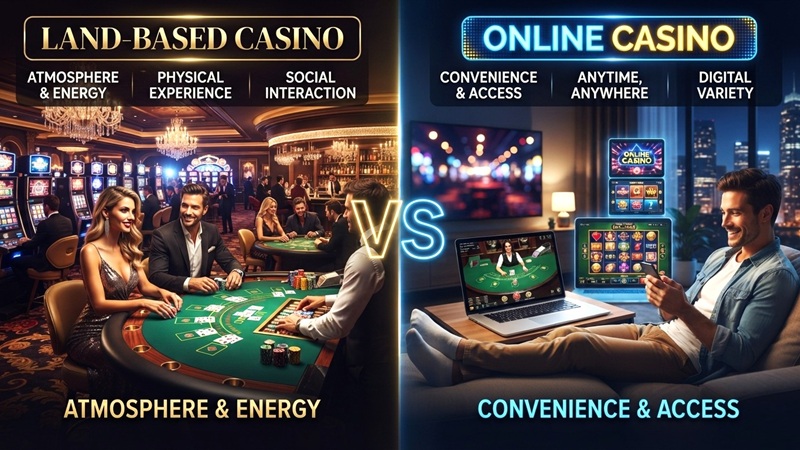
For all the progress made by online casinos, there is one thing the digital experience still struggles to reproduce: the feeling of actually being there. Technology has transformed almost every part of the gambling experience. Players can access a wider range of games from almost anywhere, move between products instantly and interact with sophisticated interfaces. Live casino products have also narrowed part of the gap by introducing real dealers, streaming studios and more immersive environments.
Yet a physical casino offers something that cannot be reduced to a screen, a live stream or a user interface. It creates an environment in which gaming exists alongside hospitality, entertainment, social interaction, food, retail and events. The experience is spatial, sensory and social. That distinction is becoming relevant as land-based operators rethink what their properties are designed to deliver.
The value of being there
The strongest argument for physical casinos is not necessarily the game itself. A roulette wheel, blackjack table or slot machine can now be accessed digitally with remarkable convenience. The difference is everything surrounding the game.
Walking into a casino involves architecture, lighting, sound, human interaction and a sense of occasion. A player can move from the gaming floor to a restaurant, attend a concert, meet friends, stay at a hotel or participate in an event without leaving the property. This makes the physical casino closer to an entertainment destination than a gaming platform.
Integrated resorts have been building their strategies around this idea for years. In Macau, for example, major operators combine gaming with hotels, restaurants, retail, conventions and entertainment. MGM Macau and MGM Cotai together offer thousands of hotel rooms, restaurants, convention space, retail and other non-gaming attractions alongside their casino operations. The same logic is visible at Wynn Palace, which combines gaming with luxury accommodation, restaurants, retail, entertainment, wellness and convention facilities.
The implication is important: the physical casino does not have to win the online convenience battle. It can compete on a different set of variables.
Social interaction remains difficult to digitize
One of the most obvious differences between physical and digital gaming is the presence of other people. Online casinos can create chat functions, multiplayer environments and live-dealer products, but these remain mediated experiences. A physical gaming floor places players, dealers, staff and spectators in the same environment.
That social dimension can be valuable for casino resorts seeking to attract visitors who are looking for an evening out rather than simply a gaming session. It also changes the role of customer service. In a digital environment, personalization is based on data, recommendations and automated interactions. In a physical property, employees can recognize a returning customer, respond to a request immediately, recommend a restaurant or show, and shape the experience through direct interaction. This does not make physical service inherently better. It makes it different.
Hospitality becomes part of the gaming proposition
The modern integrated resort demonstrates another limitation of the online model: the ability to combine multiple forms of consumption in one physical journey. A customer may arrive for dinner, attend a sporting event, visit a luxury store, spend time at a spa and eventually enter the casino. Another visitor may come primarily for a concert or conference and interact with the gaming floor almost incidentally.
That creates opportunities for operators to reach consumers who would never consider an online casino visit as a leisure activity.
Research published in 2025 on Macau’s gaming industry found that diversification into hospitality, retail, MICE and entertainment can create revenue synergies and increase visitation. The study also highlighted the growth of non-gaming activities as a share of revenue at major integrated resorts. This is where the physical advantage becomes an economic argument rather than an experiential one.
The casino becomes part of the destination
Las Vegas remains the clearest example of how gaming can become one component of a much broader tourism ecosystem. The city attracted 38.5 million visitors in 2025 and hosted approximately 6 million convention attendees, according to the Las Vegas Convention and Visitors Authority. Even in a year marked by a decline in overall visitation, conventions remained an important stabilizing force.
The lesson for operators elsewhere is that a casino property can benefit from demand generated by activities that have little to do with gambling.
That matters as consumer expectations around travel continue to evolve. Visitors increasingly expect destinations to provide a combination of entertainment, food, culture, wellness, shopping and events rather than a single primary attraction. For land-based casinos, this creates an opportunity to position gaming as part of a broader experience.
Technology does not have to be the enemy
The argument for physical casinos should not be framed as technology versus tradition. Technology can strengthen those elements that make physical properties distinctive. Digital loyalty programs can connect online and offline behavior. Mobile applications can personalize offers and simplify hotel, restaurant and entertainment bookings. Cashless systems can improve convenience. Artificial intelligence can support customer service and operational efficiency. Data can help operators understand how visitors move across different areas of a resort.
The objective is to remove friction from the physical experience while preserving the elements that cannot be replicated online.
Macau offers an interesting example of this broader transition. Its gaming concessionaires have been required to invest heavily in non-gaming development, including tourism, conventions, entertainment, sports, culture, wellness and gastronomy. One concessionaire, for example, committed more than MOP19.8 billion to non-gaming capital projects and event programming over the ten-year concession period. Technology, in this context, becomes an enabler rather than the product itself.
The experience economy changes the role of the casino
The biggest strategic shift may therefore be conceptual. For decades, the casino floor was the center of the property. Today, the most competitive resorts are designed around an ecosystem in which gaming is one component.
This does not mean that gaming is becoming irrelevant. Macau’s 2025 results, for example, show that gaming remains a major economic engine even as operators expand their non-gaming portfolios. MGM China’s gross casino revenue rose 10.8% in 2025 to MOP39.8 billion.
The opportunity is to make the gaming proposition stronger by surrounding it with experiences that online platforms cannot provide.
A concert can create traffic. A restaurant can create an occasion. A hotel can extend the visit. A convention can introduce a new customer segment. A sporting event can bring together communities around a shared interest. The casino becomes the connective tissue between these experiences.
What online casinos still cannot replicate
The online sector will continue to win on convenience, accessibility, product variety and speed. Those advantages are fundamental and will become harder for land-based operators to compete with. But convenience is not the only reason people travel.
People still go to restaurants when they can order food at home. They attend concerts when they can watch performances online. They travel to sporting events despite having access to high-definition broadcasts. They visit hotels, museums and theme parks because physical presence itself has value. The same principle applies to casinos.
The future of land-based gaming may therefore depend less on trying to reproduce the online casino inside a building and more on understanding what a building can offer that a website never will. The winning physical casino may not be the one with the most games or the most advanced screens. It may be the one that gives people the strongest reason to leave the screen behind.