





See more of G&M News on Google
Add as a preferred source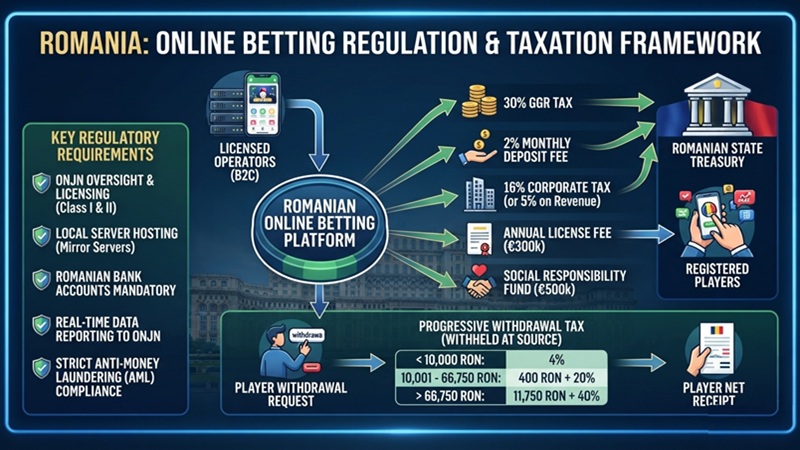
By Tatiana Martins, journalist at G&M News.
Central and Eastern Europe has been showing Romania as one of its most established regulated gambling markets. Its regulatory framework dates back to Government Emergency Ordinance 77/2009, while the National Office for Gambling (ONJN) has overseen the licensing and supervision of the sector. Online gambling has been available under the Romanian licensing framework since 2015, creating a market that has attracted both domestic companies and major international operators.
The market is now entering a different phase. Changes introduced during 2025 and 2026 have raised the cost of operating, tightened advertising rules and given municipalities a much larger role in deciding where land-based gambling can operate. For companies with significant retail networks, the changes affect the economics of the business directly. For online operators, they may accelerate a shift in investment towards digital channels.
A MARKET MOVING TOWARDS ONLINE
The most visible structural change is the growing weight of online gambling. Data cited by AGERPRES from H2 Gambling Capital estimates that land-based gambling accounted for around 48% of Romania’s regulated gambling market in 2023, compared with approximately 52% for online. By the second half of 2026, H2 estimates that the balance could move to roughly 29% land-based and 71% online.
The change is also visible in the performance of individual companies. Financial data for 2025 show Superbet Entertainment reporting RON 4.58 billion (€859.73 million) in turnover, while Kaizen Gaming International, the company behind Betano, reported RON 865 million (€161.63 million). Unibet’s Romanian operation recorded RON 368.9 million (€68.93 million), according to company-level financial data compiled from Romanian filings.
These figures should be treated carefully because Romanian corporate reporting can involve local branches, permanent establishments and different entities within the same group. They are therefore useful indicators of the scale of individual businesses, rather than a definitive ranking of total market share.
The competitive landscape includes brands such as Superbet, Betano, Casa Pariurilor, Unibet, eFortuna, Winbet, Mozzartbet, Stanleybet, and NetBet, alongside the state-owned Loteria Română. Traffic data published in February 2026 also pointed to strong digital activity, with Superbet and Betano among the most visited operator domains in the Romanian market.
The direction of travel is clear even if the precise market-share figures vary by methodology: digital acquisition, mobile products, CRM, payments, data and platform technology are becoming increasingly important to the economics of Romanian betting.
TAX PRESSURE CHANGES THE ECONOMICS
The financial environment became more demanding in 2025. Law 141/2025 introduced a new taxation framework for gambling. For online gambling, the authorization tax increased from 21% of GGR to 30%, while the minimum annual authorization tax rose from €400,000 to €480,000. For land-based fixed-odds betting, the rate increased from 21% to 25% of GGR, with the minimum annual authorization tax increasing from €200,000 to €240,000.
The changes also affected players. From August 2025, gambling winnings became subject to withholding tax at three levels: 4% for winnings up to RON 10,000; RON 400 plus 20% of the amount exceeding RON 10,000 for winnings between RON 10,000 and RON 66,750; and RON 11,750 plus 40% of the amount exceeding RON 66,750 above that threshold. For online gambling, the tax is withheld when money is transferred from the player’s gaming account to a bank account or similar withdrawal method.
For operators, the impact is broader than the headline tax rate. Higher GGR taxation reduces the amount available to cover marketing, technology, payment costs, bonuses, staff and other operating expenses. This makes scale more valuable and puts greater pressure on operators to understand customer economics at a granular level.
FDJ UNITED, which operates Unibet in Romania, has specifically cited the Romanian tax increase among the gaming tax changes that affected its 2026 financial performance. The company said the cumulative effect of gaming tax increases across several markets, including Romania, had an impact of almost €24 million on its first-half 2026 results.
LAND-BASED GAMBLING FACES A NEW LOCAL TEST
For retail operators, perhaps the most consequential change came in February 2026. Government Emergency Ordinance 7/2026 amended Romania’s gambling legislation to require local operating authorization for physical gambling locations. Local councils can now decide whether gambling activities are permitted within their administrative territory and, if they are, determine the areas where such activities can operate and establish an annual local authorization fee based on the size of the premises. That represents a significant change in the relationship between national licensing and local market access.
Previously, a national gambling license and operating authorization provided the basis for activity across Romania, subject to the applicable legal requirements. Under the new framework, physical operators also have to deal with decisions made at municipal level. The result is a more fragmented operating environment for companies with large retail estates.
The effect is already visible in the number of physical gaming machines. According to data cited by AGERPRES from H2 Gambling Capital, Romania had approximately 80,000 slot machines two years ago, compared with around 36,000 in 2026. The same source estimates that approximately 1,310 gaming halls remain open, operated by about 69 license holders.
This change creates a strategic question for operators: how much capital should remain tied to physical locations when the regulatory environment can vary from one municipality to another? For some companies, the answer may be consolidation. For others, it may be a smaller retail footprint supported by a stronger digital operation.
ADVERTISING IS BECOMING MORE RESTRICTIVE
Romania is also tightening the rules governing gambling advertising. The country’s new Audiovisual Content Regulatory Code, which entered into force in August 2025, introduced a prohibition on gambling advertising featuring public, cultural, scientific or sports personalities, as well as people whose online notoriety could encourage gambling participation. The National Audiovisual Council (CNA) has subsequently monitored and sanctioned broadcasters for violations of the provision.
The rules also place restrictions on when gambling advertising can be broadcast. Under Article 109 of the Audiovisual Code, gambling programs and gambling advertising are prohibited between 6:00 and 23:00, with an exception allowing betting advertisements during live sports broadcasts.
For operators, this changes the role of brand marketing. Sponsorship and sports partnerships remain part of the market, but traditional celebrity-led campaigns face tighter limits. Operators have greater incentives to develop direct digital relationships with customers through owned platforms, CRM, loyalty programs and content.
That shift also has implications for affiliates and other acquisition partners, particularly as regulators continue to distinguish between licensed operators and unauthorized gambling activity. Romanian legislation provides for penalties and confiscation in cases involving the advertising or promotion of unlicensed gambling.
THE ILLEGAL MARKET REMAINS PART OF THE EQUATION
A regulated market cannot be assessed through licensed operators alone. Romania’s regulatory framework has become more demanding partly because authorities are seeking greater control over gambling activity and its social impact. The latest reforms give local authorities a direct role in physical gambling locations, while the national regulator continues to oversee licensing and compliance.
At the same time, higher taxes and operating costs raise a familiar question for regulated markets: whether tighter conditions can be implemented without pushing customers towards unlicensed alternatives.
The answer will depend on the effectiveness of enforcement, the visibility of legal operators and the quality of the consumer experience they offer. Technology has a role here. Payment controls, identity verification, player monitoring and responsible gambling systems can help licensed businesses distinguish themselves from offshore or illegal alternatives, while regulators can use data to monitor activity more efficiently.
WHAT COMES NEXT FOR ROMANIAN BETTING
Romania’s market is moving towards a model in which digital scale matters more, while physical operations face greater regulatory and economic constraints.
The country’s 2025 tax reforms have raised the cost of participation for operators, while the 2026 local authorization system has introduced another layer of complexity for retail businesses. Advertising restrictions have also changed how brands can communicate with consumers.
At the same time, the market remains commercially significant. Romanian corporate data show large revenues across the leading gambling companies, while international groups continue to operate alongside strong domestic brands.
The next stage will therefore be less about whether Romania remains an attractive gambling market and more about which operating models can remain sustainable under the new regulatory economics.
For online operators, this points towards investment in product, mobile experience, payments, CRM, data and responsible gambling technology. For land-based businesses, the priority may be network optimization, local regulatory management and tighter integration between retail and digital channels.
The result could be a Romanian market that is smaller in physical footprint but more concentrated, more digital and more dependent on technology and operational efficiency.
For companies looking at Central and Eastern Europe, Romania remains a market worth watching. Its regulatory direction also offers a useful indication of a broader regional question: how far governments can tighten gambling controls while maintaining a viable licensed market and keeping consumer activity within the regulated system.