See more of G&M News on Google
Add as a preferred source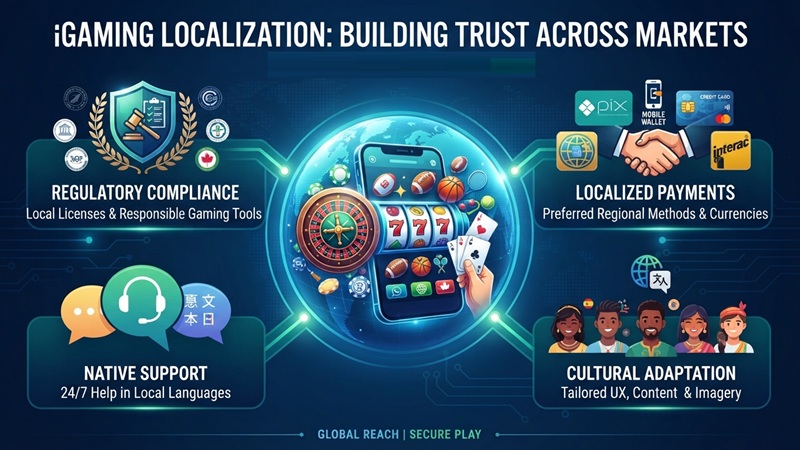
By Tatiana Martins, journalist at G&M News.
Expanding an iGaming operation into a new market involves much more than translating a website or making a platform available in another language. Every market has its own linguistic conventions, cultural references, communication expectations and regulatory requirements. Adapting a product to these differences requires coordinated work across technology, content, customer support, game development and compliance.
Localization plays a central role in this process. When properly planned, it helps operators communicate product features clearly, present promotional conditions accurately and provide a consistent experience across different languages and jurisdictions. It also reduces misunderstandings that can affect customer service, operational efficiency and the relationship between brands and players.
For companies operating internationally, the challenge is to ensure that the meaning of information remains consistent throughout the entire player journey. A translation that sounds natural but changes the meaning of bonus condition, a game instruction or a payment requirement can create problems that extend well beyond the language itself.
Building a reliable localization process therefore requires a combination of linguistic expertise, technical knowledge, cultural awareness and systematic quality assurance.
Localization starts before entering a new market
One of the most common mistakes in international expansion is treating localization as a final step in product development. When translation begins only after a platform has been completed, teams may discover that certain interface elements, promotional formats or technical components are difficult to adapt. A more effective approach is to incorporate localization into the initial planning stages.
Before entering a new GEO, operators should identify the languages and regional variations required, the terminology commonly used by local audiences, relevant payment methods and the regulatory requirements affecting product communication.
Language selection also deserves attention. Portuguese, for example, differs between Brazil and Portugal in vocabulary, expressions and communication conventions. Spanish presents similar challenges across Latin America and Europe. A translation that works in one country may sound unnatural or create confusion in another.
The same principle applies to English, which can vary considerably depending on the target audience and market.
Companies should therefore define the linguistic profile of each market rather than rely exclusively on generic translations. This includes identifying preferred terminology, spelling conventions, currency formats, date presentation and the tone used in customer-facing communications.
A localization brief can help organize these requirements and establish responsibilities among translators, marketing teams, product managers and compliance specialists.
Promotional terms and game instructions require precision
Among the most sensitive elements of iGaming localization are bonus conditions, promotional campaigns, payment instructions and game rules.
These materials contain information that players need to understand before making decisions. A translation that changes the meaning of a wagering requirement, minimum deposit, withdrawal condition or promotional restriction can create misunderstandings between the operator and the customer. For this reason, promotional content should not be translated as ordinary marketing copy.
Specialized translators need to understand the terminology and mechanics behind the products they are working with. They must also distinguish between creative language, which allows some flexibility, and contractual or operational information, which requires greater precision.
Consider a bonus campaign involving a wagering requirement. If the translated version does not clearly explain how the requirement works, which contributions apply and when the bonus expires, the player may develop expectations that differ from the actual promotional conditions.
The same applies to game instructions. Terms related to paylines, multipliers, free spins, jackpot features and game mechanics must remain consistent across languages. Players should be able to understand how a game works without encountering contradictory descriptions between the interface, help section and promotional materials.
A practical solution is to establish a terminology database, commonly known as a translation glossary. It should contain approved translations for product names, game mechanics, promotional terms, payment expressions and other recurring concepts.
This resource helps different teams maintain consistency and reduces the time required to review new content.
Cultural adaptation without changing the product’s meaning
Localization also involves understanding how audiences communicate and interpret information. A campaign that performs well in one market may require adjustments in another because humor, expressions, visual references and communication styles do not necessarily translate directly.
This is where transcreation becomes relevant. Unlike direct translation, transcreation adapts the creative message to the cultural context of the target audience while preserving its original intention.
For marketing teams, this can involve adjusting headlines, calls to action, campaign concepts and social media content. However, creative adaptation must respect the product’s actual features and the conditions attached to promotional offers.
Cultural awareness also extends to visual communication. Colors, symbols, gestures, images and references can have different meanings depending on the audience. Even the way information is organized may influence how easily users understand a platform.
The objective is to make the product feel familiar and accessible without creating inconsistencies in its functionality or communication.
For international operators, this requires collaboration between global brand teams and professionals who understand the local market. Native-language reviewers can identify expressions that are technically correct but sound unnatural to local users.
Building a consistent multilingual customer support operation
Localization does not end when a player registers or starts using a platform. Customer support must maintain the same level of clarity and consistency throughout the relationship.
Multilingual support teams need access to accurate product information, approved terminology and updated explanations of promotional conditions, payment procedures and account requirements.
One potential problem arises when the marketing team, platform interface, and customer service department use different translations for the same concept.
For example, a player may encounter one expression when reading a bonus offer, another when accessing the account section and a third when contacting customer support. Even when the underlying information is correct, inconsistent terminology can make the experience confusing.
A shared knowledge base can help prevent these discrepancies. It should include standardized answers to frequently asked questions, explanations of product features, promotional conditions and escalation procedures for more complex cases.
Training is equally important. Support agents need to understand not only the language but also the products they explain. A fluent speaker without sufficient knowledge of gaming terminology may struggle to clarify technical questions or distinguish between different promotional mechanics.
Operators should also monitor recurring customer inquiries in each language. Repeated questions about the same feature, bonus condition or payment process may indicate that the original communication needs improvement.
Customer support can therefore become an important source of information for localization and product development teams.
Quality assurance: testing language as part of the product
A translation can be linguistically accurate and still fail when integrated into a digital product. Text may exceed the available space in a button, become difficult to read on mobile devices or appear incorrectly when special characters are not supported. Some languages also require more space than the original version, affecting menus, banners, notifications and other interface components.
These issues make localization quality assurance an essential part of product testing. A comprehensive process should include linguistic review, functional testing and visual inspection.
Linguistic quality assurance checks terminology, grammar, consistency and whether the translated content preserves the original meaning. Functional testing examines how the localized version behaves within the platform, including navigation, forms, notifications and interactive elements.
Visual testing focuses on the presentation of text and other localized elements across devices and screen sizes.
Game testing requires additional attention. QA specialists should verify that game instructions, paytables, feature descriptions and other information match the actual mechanics. They should also check whether translations remain consistent across the game interface, help documentation and related promotional materials.
A structured review process can involve several stages:
- Translation: specialized linguists produce the initial localized content using approved terminology.
- Linguistic review: a second professional checks accuracy, readability and consistency.
- Product integration: developers implement the translated content in the platform or game.
- Functional and visual QA: testers evaluate how the localized product works across different devices and interfaces.
- Final validation: local market specialists and relevant compliance teams review the material before publication.
Automation can support several stages, particularly terminology checks, identification of missing translations and detection of text inconsistencies. However, human review remains essential for evaluating meaning, cultural appropriateness and the clarity of complex information.
Artificial intelligence and the role of specialized linguists
Artificial intelligence and machine translation tools have changed the way companies manage multilingual content. They can help process large volumes of text, accelerate initial translations and support terminology consistency across multiple projects.
For iGaming operators, these tools may be useful when updating interfaces, producing internal documentation or managing recurring content across several markets. However, speed does not automatically guarantee quality.
Automated systems may misunderstand industry-specific terminology, promotional conditions or expressions that depend on the context in which they appear. They may also produce translations that are grammatically correct but inconsistent with the language used elsewhere in the product.
The distinction between a marketing headline and a bonus condition is particularly important. The former may require creative adaptation, while the latter must preserve precise information.
A practical approach is to combine machine-assisted translation with professional review. Specialized linguists can correct terminology, identify ambiguous expressions and ensure that the final content communicates the intended meaning.
The level of human review should reflect the importance and complexity of material. Game rules, payment instructions, account conditions and responsible gaming information deserve particular attention. Technology can improve productivity, but linguistic accountability must remain part of the process.
Measuring localization performance
Localization should also be evaluated through operational indicators rather than treated exclusively as a content production activity. Operators can monitor several metrics to understand whether localized products are meeting user expectations and supporting business objectives.
Conversion rates across registration and deposit stages may help identify differences in how audiences respond to localized interfaces. However, these figures should be interpreted alongside traffic sources, acquisition campaigns and other market-specific factors.
Customer support data can reveal whether players are struggling to understand particular features or promotional conditions. Repeated inquiries, complaints related to unclear terms and requests for clarification can indicate sectors where communication needs improvement.
Other useful indicators include translation error rates and the number of corrections required after publication; consistency of terminology across platforms, games and communication channels; customer support resolution times by language; frequency of complaints involving misunderstood promotional or payment conditions; completion rates for registration and other essential user journeys, and time required to update and approve localized content.
These indicators can help teams identify recurring problems, prioritize improvements and evaluate the effectiveness of their localization procedures.
It is also important to distinguish linguistic problems from other operational factors. A lower conversion rate in a particular GEO does not necessarily indicate a translation issue. Payment availability, traffic quality, product preferences and market conditions may also influence performance.
Combining quantitative data with feedback from local users and customer support teams provides a more complete picture.
Localization as a long-term investment in international operations
Entering a new market is a complex process, and language is one of the elements that connects every stage of the operation. From the first marketing message to game instructions, payment information and customer support, communication needs to remain clear and consistent.
For iGaming operators and technology providers, investing in specialized translators, terminology management, local market expertise and structured QA procedures can help reduce operational friction and strengthen the relationship with players.
The most effective localization strategies are built around collaboration. Marketing teams, linguists, developers, game testers, compliance specialists and customer support professionals need to work with shared information and clearly defined responsibilities.
As companies expand their international presence, localization should be treated as an ongoing product management process rather than a one-time translation project.
A well-localized platform communicates product features accurately, makes information easier to understand and creates a consistent experience across every point of interaction. For an industry operating across different languages and regulatory environments, this level of attention can become an important part of sustainable international growth.