








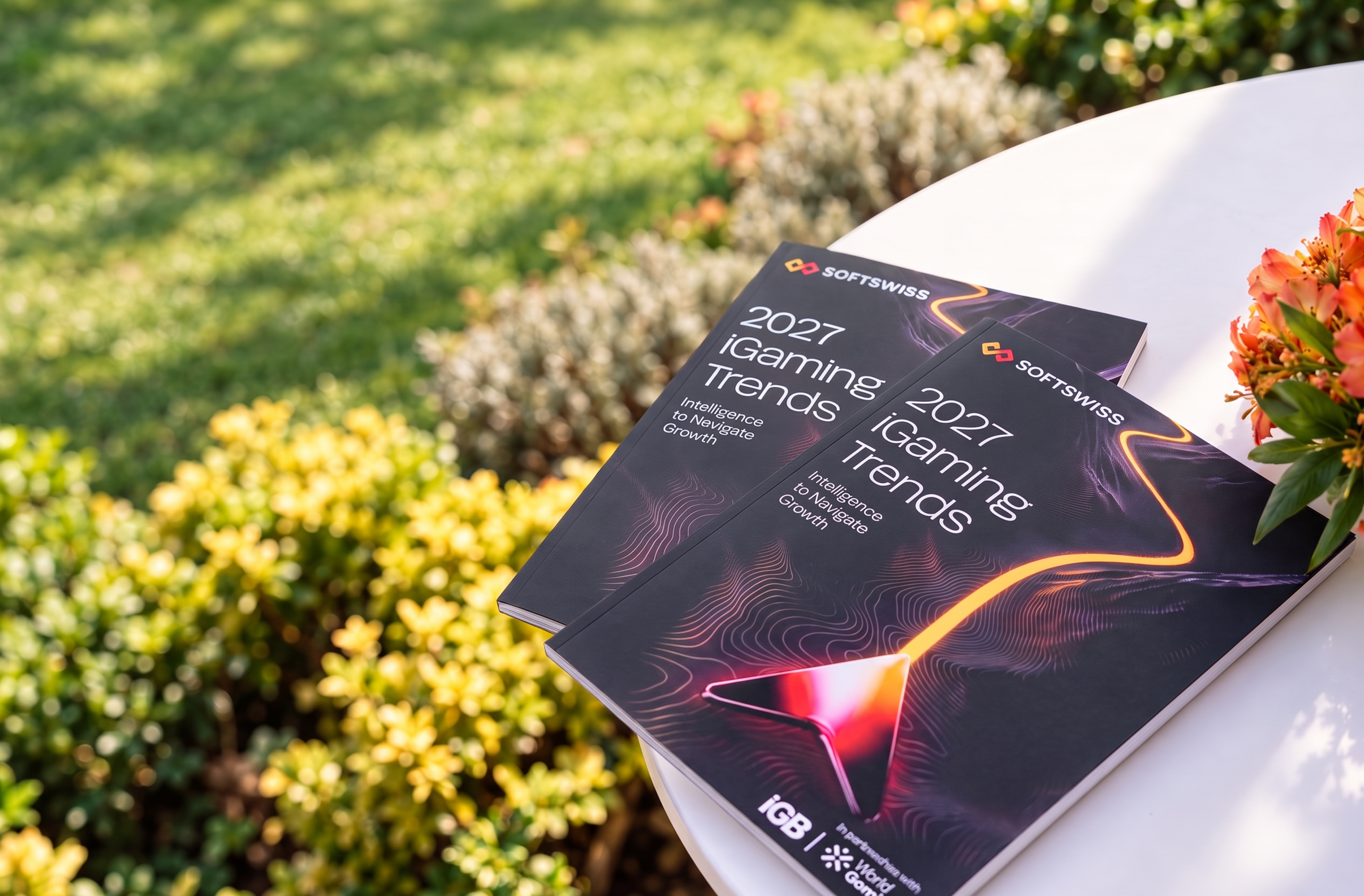
The global iGaming industry is emerging as an early test bed for emerging tech, including AI, that are reshaping fintech, SaaS, e-commerce and other digital businesses, according to the newly released 2027 iGaming Trends Report, produced by SOFTSWISS in partnership with WorldGaming (formerly Clarion Gaming).
Now in its fifth year, the annual report draws on a survey of more than 500 iGaming professionals, insights from over 65 industry experts, and desk research, alongside proprietary market data and contributions from WorldGaming, Amazon Web Services (AWS), Pentasia, BGaming and FinteqHub. The research looks beyond online gambling to examine how developments in AI, cybersecurity, payments, regulation and HR are playing out in a high-load, highly regulated digital industry.
A Fast-Growing Digital Market
The global iGaming market is expected to generate €307.3 billion in gross gaming revenue in 2026, ranking fourth in the report’s benchmark of eight industries with significant digital business models, behind e-commerce, sports and film, according to H2 Gambling Capital data. Having recorded a compound annual growth rate of 29.95% between 2019 and 2026, the sector is forecast to grow by a further 9% annually between 2027 and 2031, reaching approximately €461.84 billion in gross gaming revenue by 2031.
The report argues that the same pressures that have driven iGaming to grow and mature quickly are now pushing the sector towards new approaches to AI-era workforce design, cybersecurity and regulation. SOFTSWISS’s Digital Maturity Index gives iGaming a maturity score of 4.67 out of 5, the highest of the eight industries assessed, based on AI adoption, mobile-first infrastructure, digital customer acquisition, payments innovation, RegTech adoption and data-driven decision-making.
Alexandra Kavelich, Deputy Chief Marketing Officer, commented:
“iGaming is often viewed as a specialist entertainment sector, but the technology behind it addresses many of the same challenges facing every digital business: processing transactions in real time, protecting consumers, detecting fraud, personalising products and operating across multiple regulated markets. The difference is the speed and intensity at which these pressures converge. This makes iGaming an early indicator of what could come next for fintech, SaaS, e-commerce and the wider digital economy. Technologies being tested at scale in our industry today are likely to become standard operating infrastructure elsewhere tomorrow.”
AI, Workforce and Cybersecurity
The 2027 report finds that AI proficiency is becoming a baseline expectation across product, marketing, technology and operations, while businesses are using leaner teams and creating new roles including AI product managers, AI artists, heads of AI and AI engineers. At the same time, dedicated Chief Product Officer roles are becoming rarer as product responsibilities spread across technology, marketing and the C-suite.
The report identifies cybersecurity as another area where AI has raised the stakes by making impersonation and social-engineering attacks more convincing and scalable. Fintech accounted for 44.2% of DDoS incidents recorded by Qrator Labs in the first quarter of 2026, while betting ranked among the three most frequently targeted sectors. Cybersecurity, fraud, payments, AML and identity have traditionally been managed as separate functions, but that structure can leave each team seeing only one part of an attack. There is a growing need to connect signals across all of them.
AI, Regulation and the Future of Digital Business
The third shift is emerging at the intersection of AI, regulation and consumer discovery. While companies deploy AI internally, regulators are doing the same: 85% of financial-sector authorities in advanced economies already use AI-powered supervisory technology, according to research cited in the report. At the same time, consumer-facing AI is creating a different challenge. A March 2026 investigation cited in the report found that ChatGPT, Gemini, Copilot and Grok could all be prompted to recommend unlicensed offshore casinos. There is currently no formal requirement for general-purpose AI assistants to verify whether a business is operating legally before recommending it, but the report argues that scrutiny of filtering, suppression and licence verification is likely to increase.
Taken together, the findings suggest that the next phase of AI adoption will be organisational and regulatory as much as technological. In a sector where AI, payments, identity, cybersecurity and regulation already intersect at scale, iGaming offers a live test case for changes that will increasingly affect fintech, SaaS, e-commerce and other digital industries.
The 2027 iGaming Trends Report by SOFTSWISS is available to download online.
About SOFTSWISS
SOFTSWISS is a global technology company supplying award-winning software solutions for iGaming since 2009. Supported by a team of more than 2,000 experts, SOFTSWISS serves over 1,200 brands worldwide through its comprehensive product ecosystem.