









A step-based casino round takes a repeated action and gives it a visible direction. A character advances along a route, progress is divided into separate steps, and the player has defined controls for moving or ending play. The structure comes from the relationship between those elements. Each action belongs to a round with its own rules, rather than existing as an isolated animation.
Within that route, a step and a player input are different units. Progress is recorded in steps, while a single input can request more than one movement. The stopping action also has its own conditions. A complete description needs to account for those differences, so the visible journey and the controls tell a consistent story about how the round proceeds.
The chicken road slot gives this structure a concrete form: a chicken moves from Bomb Site B toward Bomb Site A in a Counter-Strike setting. Safe steps increase the multiplier, and cashing out is available after a safe step during single-step play. The route establishes direction, while the steps divide progression into distinct parts. The setting supplies a recognizable premise; the movement and stopping rules define the casino activity.
The Action That Holds the Round Together
Character position records spatial progress along the route. The multiplier expresses a payout as a multiple of the stake. A safe step changes both, linking movement with a numerical update. The relationship between them belongs to the rules; the way they appear on screen is a separate presentation choice.
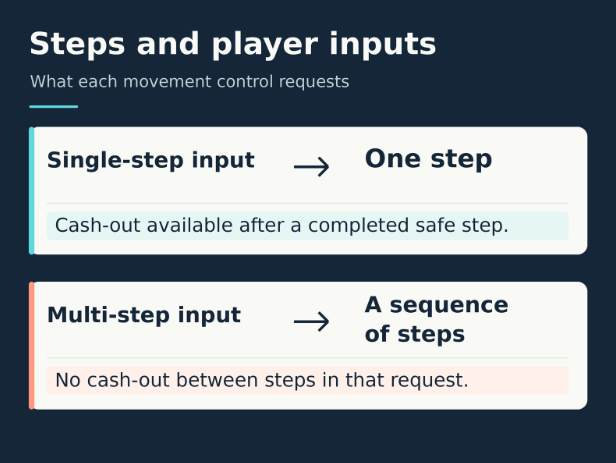
The manual controls also distinguish a step from an input. Selecting the first coin requests one step; selecting a coin farther along the route requests a sequence of steps. One command can therefore cover multiple units of progression. This distinction belongs in the description of the interaction, because counting clicks would give a different account of the round from counting steps.
In single-step play, cashing out is available after a completed safe step. A multi-step request groups successive steps, with no cash-out action between them. Cash-out availability depends on how movement was requested, as well as whether a step has been completed safely. The unit of progress remains a step, while a chosen input determines how many steps are requested as part of one sequence.
Cash-out also means that the route’s destination and the end of a round are separate concepts. The map gives movement a direction, while the rules explain when a round can finish. Treating the picture as the full rule set would leave that distinction unexplained.
Refining the Core Instead of Adding Systems
Feature restraint is a documented development choice beyond casino gaming. In 80 Level’s interview with the Dorfromantik developers, Toukana Interactive describes repeatedly questioning whether proposed features were necessary and improved the experience. The team chose to refine a core that it already considered strong. Its account also describes reinterpreting existing buildings and tiles for a medieval setting while keeping the established system from becoming overloaded. The existing ruin tile was reimagined as a castle in its prime.
The work described in the interview separates changes to a game’s appearance from changes to its underlying activity. The medieval designs reinterpreted existing elements, while feature proposals faced a separate question about whether they improved the experience. Both forms of development were evaluated against the core the team intended to preserve.
For a step-based round, the central relationship remains movement through a route governed by defined rules. Additional visual treatment can develop the character or surroundings without becoming another mechanic. The design question is whether an addition supports that relationship or creates another activity requiring its own explanation.
The team’s early art style sheet covered shapes, proportions, lighting, colors, and perspective. Those guidelines supplied a consistent basis for evaluating visual material. The developers judged shapes from the actual in-game perspective, giving clear silhouettes priority over detail. For a route-based game, the corresponding task is to preserve a clear view of movement while developing its setting. The character and surroundings have different roles: one marks progress, while the other gives that progress a place.
Making the Main Action Legible
Presentation has to support those connections. Thumbsticks’ account of Arranger’s art direction reports how artist David Hellman approached a puzzle game whose grid shifts with character movement. An experiment with a 2.5D treatment introduced complications involving depth and object layering. The team returned to 2D and gave the gameplay grid visual priority, with scenery suggesting the surrounding world. Comic-style background fragments allowed character and story details to occupy that surrounding composition without interrupting the grid-based interaction.
For a route-based casino game, the playing space needs to distinguish the character’s current position from the part of the route still ahead. Scenery can establish the setting without taking over the display of progress. Arranger’s grid-specific solution illustrates this separation, while the casino game’s own rules determine what the route must communicate.
Animation can show a character moving, but it does not define the extent of a player input. The same route supports a single step and a requested sequence. That difference needs to remain explicit in the controls and rules, alongside the visual account of movement.
The design of a compact round is therefore detailed work at a small scale. Its completeness comes from connected rules, readable progress, and an explicit cash-out action. The art places the character and route in view, while the controls and multiplier communicate the rules of the round.