





See more of G&M News on Google
Add as a preferred source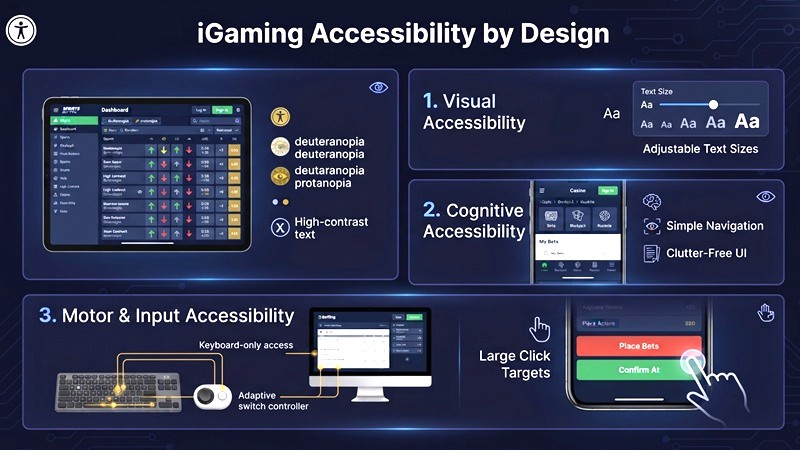
By Tatiana Martins, journalist at G&M News.
Digital accessibility is an important consideration for companies developing online products, yet the iGaming industry still faces questions about how effectively its platforms accommodate players with different needs. From the readability of game interfaces to the compatibility of account systems with screen readers, accessibility depends on decisions that extend far beyond visual design.
For players with visual, auditory, motor or cognitive disabilities, seemingly minor interface elements can determine whether a platform is usable. Small text, insufficient color contrast, unlabeled buttons, complex navigation and animations that cannot be disabled may create barriers that prevent users from completing essential tasks.
The challenge for iGaming operators and technology providers is to understand accessibility as a fundamental component of product development rather than a technical adjustment introduced after a platform has been built.
Accessibility extends beyond visual design
The Web Content Accessibility Guidelines (WCAG), developed by the World Wide Web Consortium (W3C), provide an internationally recognized framework for making digital content more accessible. The guidelines address four fundamental principles: content must be perceivable, operable, understandable and robust.
The latest WCAG 2.2 recommendations include requirements covering contrast, keyboard accessibility, focus visibility, target sizes and other aspects of digital interaction. Although originally developed for web content, the guidelines also provide valuable direction for applications and software interfaces.
According to the W3C, accessibility improvements can benefit people with a wide range of disabilities, including visual, auditory, physical, speech, cognitive and neurological impairments. They can also improve usability for people experiencing temporary limitations or accessing digital products under different conditions.
In iGaming, these principles have implications for nearly every stage of the player journey, including registration, account management, navigation, game selection, customer support and responsible gaming tools.
A platform may appear visually polished while still presenting significant accessibility barriers. A button that relies exclusively on color to communicate its status, for example, may be difficult to interpret for someone with color vision deficiencies. Similarly, a promotional banner containing essential information without a text alternative may be inaccessible to users relying on screen readers.
Accessibility therefore requires developers to examine how information is communicated and how players interact with each component.
Navigation, readability, and interaction
One of the most immediate accessibility considerations is readability. Text must remain legible across different screen sizes, resolutions and viewing conditions. Players with low vision may need to enlarge text or adjust display settings without losing access to essential information.
Color contrast is equally important. Interfaces that use similar shades for text and backgrounds can make information difficult to distinguish. The WCAG 2.2 AA standard establishes minimum contrast ratios of 4.5:1 for normal text and 3:1 for large text, subject to defined exceptions.
These requirements can influence how developers design game menus, account dashboards, promotional content, buttons and notifications. Keyboard navigation presents another challenge. Some users cannot operate a mouse and depend on keyboards, alternative input devices or assistive technologies. Every essential function should therefore be accessible without requiring mouse interaction.
Players should be able to navigate menus, activate controls, complete forms and identify their current position within an interface. Visible keyboard focus is important because it helps users understand which element is selected.
Complex interfaces can become difficult to navigate when focus moves unpredictably, interactive elements are inaccessible or important controls are hidden within menus. Screen reader compatibility is another critical area. Screen readers convert digital content into speech or braille, allowing users with visual impairments to navigate interfaces and access information.
For this technology to work effectively, interface elements must have meaningful labels, appropriate semantic structure and clear descriptions of their purpose. A button identified only by an unexplained icon may be visually recognizable but provide little useful information to someone using a screen reader.
These considerations become relevant when interfaces contain dynamic information, including account notifications, changing balances, game controls and interactive menus.
Gaming interfaces and the challenge of motion
Gaming products present additional accessibility considerations because their interfaces frequently combine animation, sound, visual effects and interactive elements. Motion can contribute to the visual identity of a game, but certain effects may create difficulties for people with vestibular disorders, photosensitivity or other neurological conditions. Rapid animations, flashing elements and continuous movement can affect how comfortably users interact with a platform.
Providing options to reduce or disable nonessential motion can help address these concerns. Developers should also consider whether animations interfere with navigation, obscure information or prevent users from completing tasks at their own pace.
Audio presents a similar challenge. Essential information should not depend exclusively on sound, when users cannot hear audio cues or are accessing a platform in an environment where sound is unavailable.
Visual alternatives, captions where appropriate and clearly communicated interface states can help ensure that important information remains accessible.
The objective is not necessarily to eliminate the visual and auditory characteristics of gaming products. Instead, it is to provide alternative ways of accessing essential information and interacting with the interface.
Testing accessibility beyond automated tools
Identifying accessibility barriers requires a combination of technical assessments and practical testing. Automated tools can detect certain issues, including missing labels, contrast problems and structural inconsistencies. However, they cannot determine whether every interface is understandable or whether a player can successfully complete a complex task using assistive technology. Manual testing is therefore essential.
The Royal National Institute of Blind People (RNIB), in its 2022 Accessible Gaming Research report, examined accessibility challenges across gaming development and technology. The research identified the need for better support in development platforms and tools, as well as greater collaboration and knowledge sharing among developers.
The report also highlighted the importance of accessibility support within gaming platforms and development environments. For iGaming companies, testing should extend beyond individual components. A registration form may appear accessible in isolation, but the complete process could still present difficulties if users encounter inaccessible verification steps, confusing error messages or navigation barriers.
Testing should cover complete player journeys across desktop and mobile devices, different browsers and relevant assistive technologies.
More importantly, people with disabilities should participate in usability assessments. Their experiences can reveal problems that automated evaluations and conventional design reviews may overlook.
The UK Gambling Commission provides an example of how accessibility testing can be incorporated into digital maintenance. Its accessibility statement describes the use of WCAG 2.2 AA as a testing standard, alongside manual evaluations, accessibility software, different devices and research involving people who use assistive technologies. The regulator also acknowledges that some elements of its own website remain partially inaccessible, illustrating the ongoing nature of accessibility work.
This approach highlights an important principle: accessibility is not a one-time certification or a checklist completed before launch. Updates, new features and changes to third-party components can introduce new barriers, making continuous evaluation necessary.
Regulation, standards, and industry responsibility
Accessibility also raises questions about regulatory expectations and the responsibilities of companies operating across different jurisdictions. The European Accessibility Act, which began applying on June 28th, 2025, establishes accessibility requirements for certain products and services in the European Union. Its scope includes specific digital services, such as e-commerce, but the applicability of individual requirements depends on the service, business and relevant legal provisions.
For iGaming operators and suppliers, understanding these distinctions is important when evaluating accessibility obligations in different markets.
The WCAG framework can serve as a technical reference, but following a particular standard does not automatically establish compliance with every applicable law. Companies must assess their products against the requirements relevant to their operations.
Beyond regulatory considerations, accessibility can influence product quality, customer experience and the ability to reach users with different needs.
Clearer interfaces, consistent navigation, readable information and flexible interaction options can benefit a broader audience. Features designed for accessibility may also help users who experience temporary injuries, age-related changes or limitations associated with particular devices and environments.
However, accessibility should not be reduced to a commercial argument. The ability to access digital information and interact with technology is also a matter of inclusion and equal opportunity.
Building accessibility into the development process
The most effective approach begins during product planning. Accessibility requirements should be considered when defining interface architecture, selecting development tools, designing game mechanics and establishing testing procedures. Retrofitting accessibility into an existing product can be more complex when fundamental design decisions have already been made.
Product teams can establish accessibility criteria for new features, including them in quality assurance processes, and evaluate whether updates introduce new barriers.
Collaboration between UX designers, developers, compliance specialists, accessibility consultants and platform providers is essential. Operators can also contribute by identifying recurring problems through customer support channels and sharing feedback with technology suppliers.
For platform providers serving multiple operators and jurisdictions, accessibility presents an additional technical challenge. Components must remain consistent across different brands, languages, devices and product configurations.
This makes accessibility governance relevant. Clear internal standards, documentation, testing responsibilities and procedures for addressing identified issues can help companies maintain accessibility as products evolve.
The question is not whether an iGaming platform offers accessibility features. It is whether players with different needs can use those features effectively and complete essential interactions without unnecessary barriers.
Accessibility by design offers the industry an opportunity to reconsider how interfaces are developed, tested and maintained. The progress made will depend on whether companies treat accessibility as a permanent part of product quality and involve the people who experience these barriers directly in the development process.