





See more of G&M News on Google
Add as a preferred source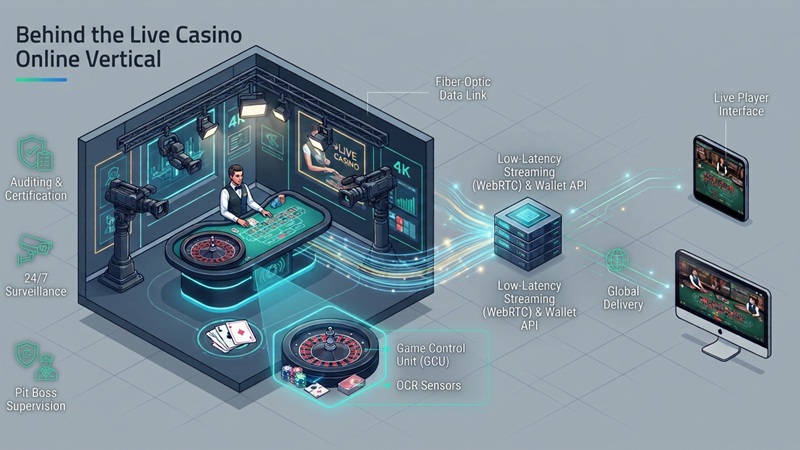
By Tatiana Martins, journalist at G&M News.
A live casino table may look simple on a player’s screen: a dealer, a deck of cards, a roulette wheel and a betting interface. Behind that experience, however, sits a complex production operation that combines gaming procedures, broadcast technology, workforce management and real-time platform integration. Unlike a digital slot game, which can serve many players without requiring a new physical production for each session, a live table depends on people, equipment and carefully coordinated shifts.
That operational model helps explain why scale matters in the live casino business. Providers must keep tables running around the clock, recruit and train dealers, maintain consistent production standards and adapt their offerings to different languages and regulatory environments. Expanding into a new market can therefore involve considerably more than translating a game interface or adding a new title to a catalogue.
A production operation that never sleeps
Live casino studios function as continuous production environments. Their operations typically combine dealers and presenters with floor supervisors, studio managers, broadcast technicians, surveillance personnel, compliance teams and technical support. Camera systems, lighting, microphones, game equipment, streaming infrastructure, and software must work together to deliver an uninterrupted experience.
The scale of these operations is visible in the networks built by major suppliers. In its 2025 annual report, published in April 2026, Evolution reported 22,475 employees and more than 800 operator customers. The company operates studios across Europe, North America, South America and Asia, with local facilities supporting markets with different regulatory requirements. Its current studio information lists more than 2,000 live tables across its global network.
Vivo Gaming provides another example of the operational footprint required to serve international markets. The supplier reports more than 200 live tables operating 24/7, serving over 75 countries, with dealers speaking more than 25 languages. These figures reflect the companies’ own published information rather than industry-wide averages.
The infrastructure required to maintain such operations also creates fixed costs. Studios need suitable facilities, equipment, connectivity, technical maintenance and staff coverage. Those expenses continue even when demand for a particular table or market is lower than expected. Providers must therefore consider not only how many tables they can launch, but also how consistently those tables will be used.
Dealers are part of the product
Recruitment and training are central to live casino operations. Dealers must understand the relevant games and procedures, handle bets accurately, communicate clearly on camera and maintain a consistent pace throughout their shifts. Depending on the role, training may also cover customer interaction, studio protocols, security procedures and the requirements of specific markets.
The workforce model introduces challenges that are different from those faced by purely digital game developers. Providers must recruit enough people to cover shifts, weekends and holidays while accounting for breaks, absences and staff turnover. A table that operates continuously cannot depend on a single dealer, and staffing requirements increase as the number of simultaneous tables grows.
Language adds another layer of complexity. Native-speaking dealers can make a product more accessible to local audiences, but multilingual production requires the right people to be available at the right times. Providers must forecast demand by language and market, then decide whether to use shared tables serving multiple operators or dedicated tables designed for a specific client or audience.
These decisions affect both cost and utilization. A dedicated table can offer more control over branding and the player experience, but it may require sufficient demand to justify the additional resources. Shared tables allow providers to distribute production costs across multiple operators, although the product may offer less exclusivity.
The economics of localization and scale
Studio expansion often involves a trade-off between centralization and local presence. A large production hub can concentrate equipment, management and technical expertise, potentially improving efficiency. However, local regulations, language preferences and demand for region-specific games can make additional studios commercially or operationally necessary.
Evolution’s international network illustrates this approach. Its locations include major production hubs in Riga, Malta and Tbilisi, alongside studios in other European markets and facilities in the Americas. The company states that some local studios are established to meet regulatory requirements for a physical presence in particular jurisdictions.
For suppliers, the challenge is to match production capacity with the commercial opportunity. Opening a studio too early can leave expensive facilities and staff underused. Waiting too long may limit a provider’s ability to serve a growing market, recruit local talent or meet requirements.
The same principle applies to the mix of games offered. Roulette, blackjack and baccarat may need different equipment, table layouts and operating procedures. Game shows and more elaborate formats can add production complexity through additional sets, lighting, props, presenters and technical coordination. Providers must evaluate whether the expected demand can support these investments.
Scale can spread certain costs across a larger number of tables, operator agreements and markets. It does not eliminate the need to manage labor, maintenance, downtime or local compliance. The commercial question is not simply how many tables a provider can operate, but how effectively its production capacity is used.
Technology supports the operation, but does not replace it
Broadcasting and platform technology connect the physical studio to players around the world. Cameras capture the game, production systems manage the video feed, and software integrations connect the table to operators’ platforms. The operation also depends on monitoring, connectivity and contingency procedures to address technical failures.
A disruption can affect more than the viewing experience. If a table becomes unavailable, operators may lose access to a product their customers expect to find in the lobby. Providers must maintain technical support and procedures for responding to equipment failures, connectivity issues and software problems, while preserving the integrity and accuracy of game outcomes.
Integration models also influence how operators enter the market. Shared tables allow an operator to access existing live casino content, while dedicated tables and studio-hosting arrangements offer different levels of control and operational responsibility. The appropriate model depends on the operator’s target markets, expected demand, branding strategy, and willingness to invest in its own infrastructure.
Technology can improve monitoring and production efficiency, but the physical operation still needs people to manage the games, facilities and technical systems. The balance between automation and human involvement is likely to remain an important consideration as suppliers seek to improve productivity without compromising reliability.
Competition will depend on more than the number of tables
The live casino sector faces a structural challenge: providers need substantial operational capabilities to deliver a consistent service, but they must also remain flexible enough to serve different market sizes and player preferences. A large network can support international distribution and a broad catalogue, while smaller or more specialized suppliers may compete through local knowledge, tailored products or a more focused operating model.
The distinction between shared and dedicated production is important. Shared tables can help operators enter the live casino segment without building and staffing their own studios. Dedicated production can provide greater control over branding and the experience but requires a commercial case strong enough to support the additional investment.
New approaches, including virtual and AI-generated dealer experiences, are also prompting questions about the cost structure of live casino production. These products may reduce some requirements associated with physical studios and human staffing, but they should not automatically be treated as equivalent to traditional live dealer games. Their technical capabilities, player acceptance and regulatory classification can differ.
For established suppliers, the challenge is to preserve the qualities that make live casino attractive while improving the efficiency of the underlying operation. For new entrants, the question is whether they can build a sustainable model without carrying the same infrastructure and staffing costs as larger competitors.
Ultimately, live casino economics are shaped by the relationship between production capacity, staffing, localization, and demand. The most competitive operation is not necessarily the one with the largest studio or the greatest number of tables. It is the one that can keep its products reliable, relevant to local audiences, and commercially viable across markets that operate around the clock.