








By Tatiana Martins, journalist at G&M News.
The headline figures in U.S. sports betting are huge, but volume alone does not explain whether an operator is building a viable business. The real story sits between the amount wagered, the share retained after payouts, and the cost of bringing bettors through the door.
U.S. commercial sportsbooks processed roughly USD 166.9 billion in wagers in 2025 and generated USD 16.96 billion in gross gaming revenue, implying a national hold of about 10.15%. Revenue grew faster than handle, a sign that product mix and pricing are becoming at least as important as market expansion.
Handle is not revenue
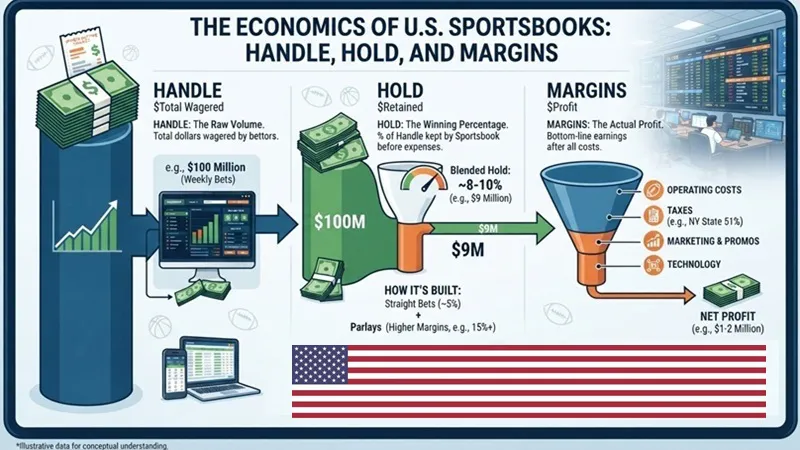
Handle is the total amount staked by customers. It is the industry’s most visible number, but it should not be confused with operator income.
A bettor who deposits USD 100, places a winning wager, then reuses the proceeds for another bet contributes to handle more than once. That makes the metric useful for measuring activity and liquidity, but not for measuring profitability. Gross gaming revenue (GGR) is the amount that remains after winning bets are paid: in basic terms, handle minus customer payouts.
The relationship can be expressed simply: GGR=Handle×Hold Percentage
For a sportsbook that takes USD 1 billion in wagers and retains 10%, GGR is USD 100 million. That figure is still not profit. It must cover promotional credits, taxes, payment processing, marketing, staff, technology, official-data agreements and corporate overhead.
Why hold matters
Hold is the share of handle retained by the operator, calculated by dividing GGR by total stakes. It is a realized result, not a guaranteed margin: a single weekend of bettor-friendly outcomes can depress the monthly figure, while a run of favorable results can lift it sharply.
The U.S. market’s annual hold reached around 10.15% in 2025, above the single-digit rates typical of the earlier post-PASPA years. That improvement reflects a more mature market, but it also points to a deliberate shift in the products being offered and promoted.
Traditional single-game bets such as point spreads and moneylines generally carry lower theoretical hold, often in the 5% to 7% range. Parlays, same-game parlays and many player-prop combinations typically deliver higher expected margins because multiple outcomes must be correct for a customer to win.
That distinction matters. An operator does not need to generate more handle to grow revenue if it can increase the proportion of betting placed on higher-margin products.
GGR versus AGR
GGR is the starting point for understanding a sportsbook’s economics, but adjusted gross revenue (AGR) is often more relevant to management teams, tax authorities and investors.
There is no single national definition of AGR. In practice, it usually refers to GGR after deductions permitted by a state, most commonly promotional credits and, in certain cases, other specified costs. The treatment varies by jurisdiction, which means a headline revenue number may not be directly comparable across states.
For operators, the distinction is material. A market can produce strong GGR but much thinner revenue after free bets, deposit matches, odds boosts and other incentives are deducted. In high-tax states, the remaining margin can be squeezed again before operating costs are even considered.
The core progression looks like this: Handle→GGR→AGR→Operating Profit
A sportsbook can appear dominant on handle while remaining under pressure on the lower lines of its profit and loss statement.
Promotions are an investment
Promotions helped create the modern U.S. sportsbook market. Early competition was defined by large sign-up offers, deposit matches, free bets and aggressive media spending as operators raced to establish brand recognition and acquire first-time depositors.
That approach was expensive. In mature states such as New York, New Jersey and Pennsylvania, estimates put acquisition costs for a first-time depositor at roughly USD 400 to USD 600, with some reports placing broader customer-acquisition costs between USD 250 and USD 750 per player.
The commercial logic is straightforward: operators spend heavily upfront in the expectation that valuable customers will remain active long enough to repay the initial outlay. The risk is that bonus-driven users depart once promotional value disappears or move between sportsbooks whenever a more attractive offer emerges.
Promotions also affect reported margins. In the first quarter of 2026, promotional spend across the U.S. online sports betting market was estimated at 30% of online sportsbook win, down from 38% a year earlier. The decline suggests the sector is becoming more selective about incentives, though the remaining impact is still substantial.
The cost of growth
Marketing is only one part of acquisition cost. U.S. operators also rely on affiliates, paid search, media partnerships, local-market advertising and sports sponsorships. Each channel carries a different economic profile.
Affiliate deals can involve a fixed payment for each customer who makes a deposit or a continuing share of gaming revenue. The second structure can be useful for managing upfront cash flow, but it can become a long-term drag on margins if a high-value player remains attached to the affiliate relationship indefinitely. Estimates cited by industry sources place fixed affiliate CPAs at USD 50 to more than USD 200 per player, while revenue-share arrangements can range from 30% to 50% of GGR.
The cost gap between channels also rewards established brands. One industry analysis estimated customer-acquisition costs of roughly USD 290 for organic or direct traffic, compared with about USD 802 for paid search. The precise numbers vary by operator and state, but the strategic point is clear: brand equity and direct acquisition are increasingly valuable.
This is why scale matters. Larger operators can spread platform costs, national advertising, data infrastructure and risk-management capabilities across a wider customer base. Smaller brands face the same broad expense categories without the same ability to dilute them.
Why football anchors the model
No sport shapes the annual economics of U.S. sportsbooks more than American football. The NFL combines national attention, a concentrated weekly schedule, deep betting menus and a customer base that is highly receptive to pre-match, live and prop wagering.
The American Gaming Association estimates that bettors will place USD 29.5 billion in legal wagers on the 2026 NFL season through regulated commercial sportsbooks. That is broadly flat on the estimated USD 29.4 billion for the prior season, but it underlines the scale of football’s role within the market.
Football is important because it drives both volume and product engagement. A regular Sunday creates a dense sequence of games, live-betting moments and prop opportunities across a limited window. For operators, that means repeated customer interaction, more cross-sell opportunities and a richer betting menu than a single traditional match-winner market.
The NFL calendar also arrives when U.S. sportsbook activity tends to accelerate. In 2025, October and November each surpassed USD 17 billion in nationwide handle, making them the strongest monthly betting periods of the year; September, December and January were also among the busiest months.
Margins can be meaningful as well. H2 Gambling Capital estimated football hold, including allocated parlay activity, at 11.4% from August 2025 through February 2026, compared with 8.6% in the preceding comparable period. Its forecast for the current NFL cycle assumes an approximately 10.9% hold, illustrating how small shifts in football performance can move industry-wide revenue in hundreds of millions of dollars.
The product mix equation
The evolution of the U.S. sportsbook business is a product-mix story. Straight bets still matter: they help build trust, serve sharper customers and provide the core markets around which the betting experience is built. But the strongest revenue growth often comes from parlays, same-game parlays, in-play wagers and player props.
These products generally offer higher theoretical margin, more frequent engagement and more room for differentiated content. They also require careful trading, transparent customer communication and responsible-gambling controls, especially when rapid betting cycles and highly personalized offers are involved.
A higher hold is not automatically a sign of a stronger business. It can be influenced by short-term sporting results, and an excessive focus on high-margin products can create retention or reputational risks. However, a sustainable mix of volume, product margin and disciplined promotional investment is what separates a headline-grabbing sportsbook from a durable operator.
From land grab to operating discipline
The first chapter of legal U.S. sports betting was about market access. The next one is about operational discipline.
With national hold around 10%, record GGR and more cautious promotional spending, the sector is moving away from the assumption that higher handle alone guarantees success. The most resilient operators will be those that understand the full equation: acquire customers efficiently, retain them responsibly, manage tax exposure, build a balanced product mix and use football’s seasonal scale without becoming dependent on one sport. In that context, handle is the starting signal, not the final score.