








By Diana Guerrero, journalist at G&M News.
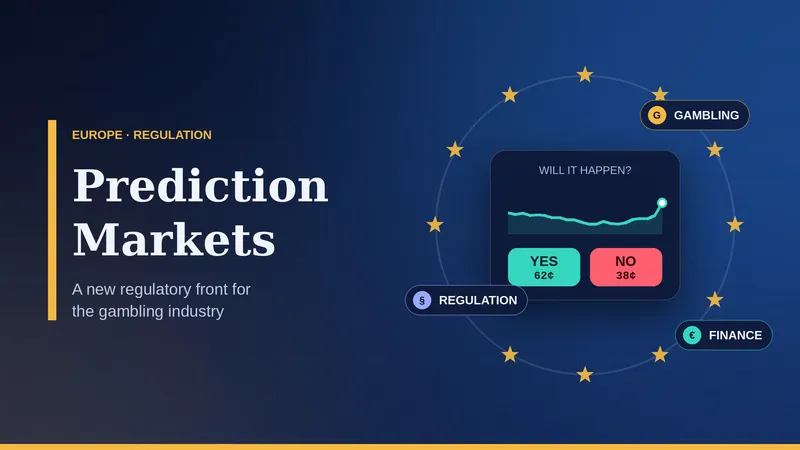
In the last couple of years, prediction markets are gaining prominence in Europe and posing a new challenge for gambling and financial services regulators. These platforms allow users to take positions on the outcome of future events, from sporting competitions and elections to economic indicators, through binary-outcome contracts. The growth of this model has raised questions over whether it should be treated as a form of betting, a financial product, or a combination of both.
The debate gained momentum in September 2026, when European Lotteries (EL) called for greater regulatory coherence in response to the expansion of these products across the continent. The organization argues that classification should depend on a product’s characteristics, economic substance and risks, rather than on the commercial name used by platforms or the technology they employ. It also contends that new models should not create regulatory gaps that allow operators to circumvent the consumer protection measures applied to traditional gambling.
In parallel, on July 2026, the European Securities and Markets Authority (ESMA) reminded firms that some event contracts may fall under EU rules on binary options and, depending on the event underlying the contract, they could also be considered betting under national legislation. This position reflects one of the phenomenon’s main issues: the same product can be subject to different regulatory frameworks depending on its structure and the country in which it is offered.
The response from European countries has also been uneven. In June 2026, regulators from Belgium, France, Germany, Italy, the Netherlands, Poland, Portugal, Spain, and Switzerland issued a joint statement warning of the risks posed by prediction markets, particularly during major sporting events. The authorities cited concerns over consumer protection, gambling limits, age verification and other safeguards that are present in regulated markets.
For the gambling industry, the growth of prediction markets opens a discussion that could extend over the coming years: how to allow innovation without creating regulatory disparities between products that may present similar risks to consumers. As Europe moves toward a more coordinated response, the debate could also redefine the boundaries between betting, financial services, and digital platforms in a market where technology is evolving faster than regulation.