







By Tatiana Martins, journalist at G&M News.
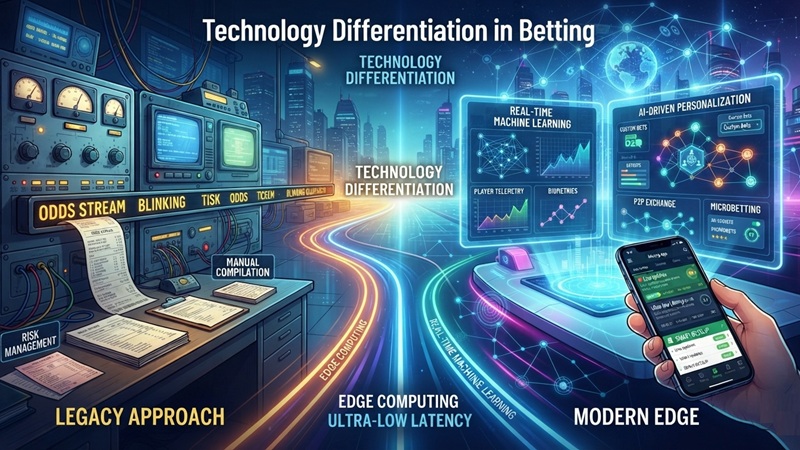
For years, technology has been one of the clearest ways for iGaming companies to gain an advantage. A faster sportsbook, better recommendation engine, more sophisticated CRM platform or stronger player analytics could separate one operator from another. That advantage is becoming harder to maintain.
Today, operators can access many of the same technology providers, AI capabilities, payment solutions, player management systems, and data tools. Platform suppliers are also offering broader technology stacks, allowing companies to enter new markets without building every component internally.
Flutter’s 2025 Annual Report illustrates the direction of travel. The group describes technology as a shared competitive capability across its brands, with investments in probability algorithms, trading tools, pricing infrastructure, product development and lower latency. FanDuel, for example, introduced new wagering formats and expanded its modelling and pricing capabilities during 2025.
Betsson is following a similar model from a different position. Its brands operate on an internally developed platform, while the company continues to invest in product and customer experience. Its 2025 annual report and 2026 communications show technology sitting alongside brand development, local market knowledge and operational execution as part of its growth strategy.
The result is a strategic question that deserves more attention: if competing operators have access to comparable technology, where does the real advantage come from?
Technology can become a commodity
Technology has traditionally been viewed as a differentiator. In many parts of iGaming, however, it is becoming closer to infrastructure. A modern operator can acquire or integrate solutions for payments, KYC, CRM, fraud detection, sportsbook trading, casino aggregation, player analytics and automated marketing. Cloud infrastructure and APIs make it possible to connect those services without developing every system from scratch. AI is accelerating this process.
A recent partnership between Weebet and Optimove in Brazil, for example, gives operators access to AI, data and automation for personalized marketing journeys. The announcement reflects a wider shift in which capabilities that once required significant internal resources can be accessed through specialist technology providers.
The implication is important. When a capability becomes widely available, simply possessing it stops being a meaningful competitive advantage.
Having AI-powered CRM does not automatically make an operator better at CRM. Having a recommendation engine does not guarantee better recommendations. Having access to the same sportsbook technology as competitors does not mean the customer experience will be the same. The technology may be similar. The execution is not.
The competitive advantage moves up the stack
It’s important to evaluate where companies should look for differentiation. Consider two operators using comparable sportsbook technology. Both can offer live betting, same-game parlays, cash-out functionality and a large selection of markets. If the underlying technology is comparable, the difference may come from how each company uses it.
One operator may have better pricing in a particular sport. Another may have a stronger mobile interface. A third may understand the preferences of its local audience more effectively. Technology provides the foundation. The business decides how to use it.
Flutter’s 2025 results offer a useful example. The company describes improvements to probability and pricing infrastructure, but the competitive value comes from how those capabilities are applied across products and markets. FanDuel incorporated coach-specific behavioral tendencies into NFL modelling, introduced price-confidence metrics and expanded odds availability late in games. Those are technology investments, but they are also examples of product strategy.
The distinction matters because competitors can purchase similar tools. They cannot simply purchase another company’s accumulated knowledge about its customers, its brand, its operating model or the way its teams make decisions.
Data becomes more valuable than software
When technology becomes easier to access, proprietary data can become a more important source of differentiation. An operator may use the same CRM platform as a competitor, but the quality, structure and interpretation of its customer data can be very different.
The same applies to sportsbook technology. Two companies can use comparable pricing infrastructure while feeding it different information, applying different risk strategies and designing different customer experiences around the resulting odds. Data alone, however, is not enough.
The advantage comes from the relationship between data, people and decision-making. A company that collects large volumes of information but cannot turn it into useful product decisions has little to show for its investment.
This is relevant as AI becomes embedded in commercial operations. If every major operator can access similar foundation models and automation tools, the differentiating factor will be what those systems are trained in, what data they can access, what problems they are asked to solve and how their recommendations are incorporated into real business decisions.
Product teams may become more important than technology teams
This could change the balance of power inside iGaming companies. A few years ago, the conversation around technology often focused on infrastructure: which platform to choose, how to migrate systems and how to improve stability and performance. Those issues remain critical, but the competitive question is moving closer to product.
How quickly can an operator launch a new feature? How effectively can it test a new betting format? Can it identify a customer problem before competitors do? Can it localize the experience for different markets without creating operational complexity?
Flutter’s 2025 technology investments demonstrate this product-oriented approach. The company linked infrastructure improvements with new wagering formats, product migrations and customer-facing features rather than treating technology as an isolated technical function. This is an important distinction for an industry where operators can sometimes look remarkably similar from a technology perspective.
Brand becomes harder to replicate
If technology converges, a brand becomes more valuable. A player does not necessarily choose an operator because it has the best backend architecture. Most customers never see technology powering the product.
They see the interface, the odds, the promotions, the payment experience, the customer service and the brand. This helps explain why major operators continue to invest heavily in brand identity even while technology becomes more sophisticated.
Flutter’s portfolio, for example, includes brands such as FanDuel, Sky Betting & Gaming, Sportsbet, PokerStars, Paddy Power, Betfair and Betnacional. The company operates with shared technological capabilities across a diverse group of brands rather than relying on a single global customer proposition.
Betsson takes a similar approach, maintaining several brands across different markets while using an internally developed platform. Its 2025 report describes brand strength and local presence alongside product investment as important parts of its strategy. Technology can be shared. The brand experience does not have to be.
Local knowledge becomes a competitive asset
This is relevant as iGaming expands across regulated markets. A platform can be deployed in multiple countries. Understanding each market is considerably harder.
Payment preferences, sports culture, language, customer expectations, regulatory requirements and promotional behavior can vary between jurisdictions. That creates an opportunity for companies that can combine scalable technology with local expertise.
The Brazilian market is a useful example. Technology providers can offer operators sophisticated CRM, automation and AI capabilities, but the commercial value depends on how those tools are adapted to Brazilian consumers and the country’s regulatory environment.
The Weebet-Optimove partnership announced in July 2026 reflects this model, combining an iGaming technology platform with player engagement technology for Brazilian operators.
The competitive question is therefore no longer whether an operator has access to technology. It is whether the company knows what to do with it in a specific market.
Speed of execution may become the real moat
There is another consequence of technology convergence: speed. If two operators have access to similar capabilities, the company that can move from idea to product faster may gain an advantage.
That could mean launching a new betting format, adapting a casino lobby, responding to regulatory changes, introducing a new payment method or changing a marketing journey.
Technology can make these changes possible. Organizational structure determines how quickly they happen. This creates an unusual situation in which companies may invest heavily in technology while their biggest obstacle is not technical at all. It may be internal bureaucracy.
A sophisticated platform is of limited value if product, marketing, compliance, trading and technology teams cannot work together quickly enough to use it.
The future may belong to companies that use technology differently
There is an important reality of modern iGaming: many operators are building their businesses on technology and content supplied by the same ecosystem of providers. This does not make differentiation impossible. It changes its location.
An operator cannot necessarily build a moat simply by having access to the latest platform, AI model or casino aggregation system. The moat may instead come from the combination of technology with proprietary data, product design, brand, local knowledge, operational discipline and the ability to make decisions quickly.
Technology is the starting point. What a company builds around it is the competitive advantage.
When technology stops being the differentiator
The iGaming industry has spent years asking which technology will transform the next stage of the market. The more interesting question may be what happens after that technology becomes standard.
AI will become easier to access. Personalization tools will become more common. Automated marketing will become part of the standard operator stack. Sportsbook and casino platforms will continue to offer broader functionality.
At that point, having the technology will be expected rather than exceptional. The winners will be the companies that can turn broadly available technology into experiences that competitors struggle to reproduce. That means better products, stronger brands, better data, faster decisions and a deeper understanding of the customer.
In other words, in the future, the competitive battle in iGaming may have less to do with who has the best technology and more to do with who can make the best use of the same technology. That could be a much harder advantage to copy.