








By Tatiana Martins, journalist at G&M News.
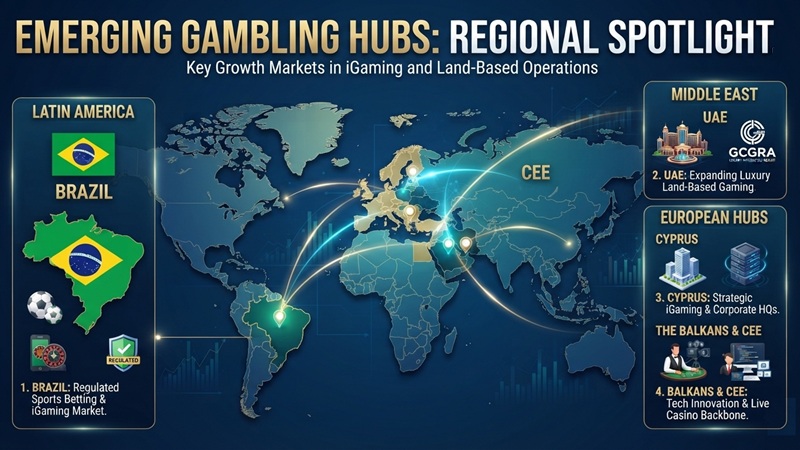
For years, Malta, Gibraltar, London, and the Isle of Man formed the familiar map of the global iGaming industry. These jurisdictions offered regulation, corporate infrastructure, specialist talent and access to established markets. That map is changing. As regulation expands and operators focus more on local execution, companies are building a more distributed international presence, with Brazil, the UAE, Cyprus, the Balkans, and Central and Eastern Europe taking on distinct roles.
This does not mean the traditional hubs are losing their relevance. Malta remains one of Europe’s largest concentrations of gaming companies. The Malta Gaming Authority reported 38 applications for new gaming licenses and 19 licenses issued during 2025, while its latest annual report shows the continued scale of the local licensed ecosystem.
Gibraltar also remains an important base for the sector. Gambling accounts for more than 20% of Gibraltar’s GDP, according to the government, and the territory continues to host major B2C and B2B businesses. At the same time, the government has acknowledged that operators are looking at jurisdictional diversification as the industry changes.
London plays a different role. The city remains closely linked to finance, investment, corporate management and professional services. The size of the British gambling market also keeps the UK central to the global industry. The Gambling Commission estimates that the Great Britain market generated £16.8 billion between April 2024 and March 2025.
The difference is that companies no longer need every part of their business to sit in the same jurisdiction.
Brazil changes the Latin American equation
Brazil is one of the clearest examples of how regulation can reshape the geography of iGaming. Since January 2025, only companies authorized by Brazil’s Secretariat of Prizes and Betting (SPA) have been allowed to operate nationally. The regulatory framework requires operators to maintain a presence in the country and comply with rules covering payments, advertising, AML, responsible gambling, and reporting.
By July 2026, Brazil’s Ministry of Finance said that 85 companies were authorized to operate in the country. The market has also reached significant financial scale. Data published in June showed betting and online gaming revenue of R$12.2 billion during the first four months of 2026, compared with R$36.9 billion throughout 2025.
For international companies, this changes the logic of entering Brazil. It is no longer enough to manage the market from a European headquarters or a regional office in another country. Operators need local compliance knowledge, payment capabilities, commercial relationships and teams that understand Brazilian consumers.
São Paulo has become particularly important as a commercial and operational center. Brazil’s scale also gives the country a role that goes beyond the traditional idea of a Latin American expansion market. It is becoming part of the operating structure of international gaming groups.
Colombia remains an important reference point because of its established regulatory framework, while Brazil brings a different level of market size and commercial potential. Across Latin America, the result is a stronger demand for local teams and regional expertise.
The UAE is building a different kind of hub
The United Arab Emirates is not yet comparable with Malta or Gibraltar as a mature iGaming jurisdiction. Its importance comes from the infrastructure and regulatory framework now being developed.
Currently, the General Commercial Gaming Regulatory Authority (GCGRA) has federal responsibility for commercial gaming in the UAE, including internet gaming and sports wagering. It is also the country’s sole authority for licensing commercial gaming activities. The regulatory structure is still taking shape. In June 2026, the GCGRA appointed Ciaran Carruthers as its new CEO as the authority continued developing its licensing and regulatory framework.
Dubai and Abu Dhabi also offer characteristics that distinguish them from Europe’s established gaming centers. They provide access to capital from the Middle East and Asia, strong international connectivity and established financial, technology and professional services sectors.
For iGaming companies, this makes the UAE relevant as a corporate and strategic base even before the local online gaming market reaches the maturity seen in Europe. It should therefore be viewed as an emerging business and regulatory hub rather than another version of Malta.
Cyprus finds its own position
Cyprus has developed a significant role for companies looking for an EU base with strong connections to Eastern European markets, particularly around Limassol.
The country operates a regulated online betting market. The National Betting Authority’s register includes international operators such as bet365, with licensed businesses based in Limassol and elsewhere on the island.
Cyprus also offers a combination of corporate services, technology talent and access to regional markets. Limassol has become an important location for management and operational teams, although the country’s role should not be confused with Malta’s broader gaming licensing ecosystem.
There is also a clear regulatory limitation. Cyprus does not allow online casinos under its domestic framework. Its online license covers electronic betting rather than a full online casino offering. That makes Cyprus a specialized hub. Companies choose it for specific business functions rather than as a universal alternative to Malta or Gibraltar.
Eastern Europe has become part of the operating infrastructure
Central and Eastern Europe offers another example of how the industry’s geography is changing. Bucharest has developed strong technology and live casino ecosystem. Warsaw combines a large technology sector with access to Poland’s regulated betting market, while Tallinn has built a reputation in technology and fintech.
These locations matter because modern iGaming companies require much more than a license and a customer-facing brand. Software engineers, game developers, data specialists, risk professionals, payment experts, customer support teams and compliance staff all form part of the industry’s infrastructure.
Romania illustrates the scale of this regional market. Industry data estimates that the country’s online gambling sector generated around €600 million in gross gaming revenue in 2024.
Regulation is also creating demand for local expertise. Romania introduced further gambling restrictions in 2026, giving municipalities greater authority over gambling venues and adding another layer of compliance for operators.
The point is not that every operator will move its headquarters to Bucharest or Warsaw. Instead, companies are building teams in these cities because the required skills and operating capabilities are available there.
The Balkans enter the strategic map
The Balkans represent another part of Europe’s changing iGaming landscape. Serbia, Bulgaria, Croatia, Romania, Montenegro, Bosnia and Herzegovina, and North Macedonia have attracted operators and suppliers looking for opportunities outside Europe’s most mature markets. In March 2026, trade associations from the seven countries established the Balkan Gaming Federation, creating a regional platform for cooperation across the industry.
The region is far from being a single market. Regulation, consumer behavior and market maturity vary from country to country. But that fragmentation creates demand for companies and professionals with detailed knowledge of local markets.
For suppliers, the Balkans offer opportunities in distribution, technology, partnerships and market entry. The region is moving beyond its former position as a collection of smaller national markets and becoming a more relevant part of European expansion strategies.
From headquarters to networks
The biggest change may be the way companies think about their own geography. The traditional iGaming model was easy to map: a company headquartered in London, licensed in Malta or Gibraltar, with technology and support functions distributed across Europe.
The current model is more complex. A company may have corporate leadership in London, licensing expertise in Malta, technology teams in Eastern Europe, a commercial operation in Brazil, and regional management in Dubai. Cyprus may support another part of its corporate structure, while Gibraltar remains relevant for established operations.
This is about reducing dependence on a small number of jurisdictions and matching each location to a specific business need. Regulation is one driver. Local compliance requirements make market-specific knowledge more valuable. Market size is another. Brazil is too large to treat as a remote expansion market, while the UAE is developing a regulatory framework with international ambitions. Talent is a third factor, pushing technology and operational functions toward cities with strong pools of specialized professionals.
The result is a new iGaming geography built around functions rather than flags. Malta, London, Gibraltar and the Isle of Man will remain important. But the next generation of international gaming companies is likely to operate across several locations, with each hub serving a different purpose. The question is no longer simply where an iGaming company is based. It is which part of the business needs to be where. That question is reshaping the industry’s global map in 2026.