








By Tatiana Martins, journalist at G&M News.
The gambling market in Bulgaria is approaching another regulatory turning point. On September 23rd, 2026, the Government announced a package of proposed amendments to the Gambling Act that would introduce what it described as a “practical” full ban on gambling advertising. The proposal is now open to public consultation and is part of a broader effort presented by the Government as an attempt to increase transparency, improve tax collection, and limit gambling problems.
The timing is significant. Bulgaria already operates under some of Europe’s tighter gambling advertising rules, following major amendments to the Gambling Act in 2024. Those changes prohibited gambling advertising on radio and television, in print and electronic media, including websites, and in public places, while allowing limited exceptions for certain billboards and the premises of licensed gambling operators. The proposed changes would take that approach further.
For operators, the issue is not simply where advertising can appear. It is how companies acquire customers, build brands and compete in a market where traditional marketing channels have already been significantly restricted.
A market that is still generating revenue
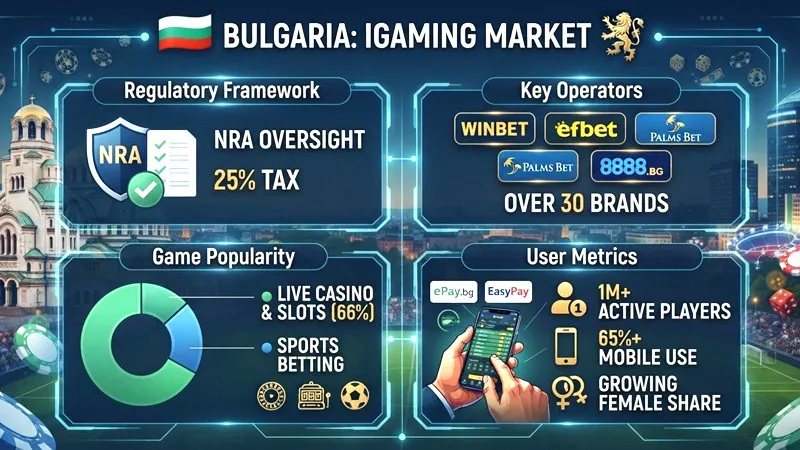
Despite the regulatory pressure, gambling remains an important source of revenue for the Bulgarian state. Industry data presented at BEGE 2025, based on information from the National Revenue Agency (NRA), showed that gambling generated BGN 503 million (€12.46 million) in state-budget revenue in 2024, a 39% increase compared with 2023. Between January and September 2025, the sector contributed almost BGN 388 million (€9.61 million) to the state budget.
The figures include several forms of gambling taxation and fees, rather than representing gross gaming revenue generated by operators. This distinction is important when assessing the size and performance of the market.
Online segment has also continued to expand. According to data presented by the Association of the Gaming Industry in Bulgaria, there were 26 online gambling organizers holding 53 licenses as of September 30th, 2025. The same industry overview pointed to a gradual decline in the number of land-based sites and gaming machines alongside continued digitalization.
This creates an important divide within the market. Retail gambling continues to have a substantial presence, but online betting and gaming are becoming a larger part of the industry’s commercial infrastructure.
Online betting has a structured licensing system
Bulgaria’s online market operates under a licensing framework administered by the National Revenue Agency. The NRA states that online betting licenses can be issued to companies established in Bulgaria, another EU member state, an EEA country or Switzerland, subject to the requirements of the Gambling Act. Operators must also meet requirements concerning their central computer systems, communications equipment and banking arrangements. A separate license is required for each type of gambling game.
The regulator maintains a whitelist of websites operated by licensed gambling companies. The current framework is designed to distinguish licensed operators from unauthorized websites, while the NRA also maintains a blacklist of websites offering gambling without a valid license. The latest blacklist available through the NRA was published in June 2026. The distinction between the two markets is increasingly relevant as acquisition becomes more difficult.
When an operator cannot rely on broad television, radio, digital-media or outdoor advertising, the value of its licensed status gets closely connected to its ability to establish a direct relationship with customers.
Product experience, search visibility, CRM, payments, loyalty, and retention can therefore become more important parts of the competitive equation.
Advertising has already changed
The proposed advertising restrictions do not come out of nowhere. In 2024, Bulgaria introduced a substantial overhaul of gambling advertising rules. The legislation prohibited gambling advertising in radio and television programs, public places, print publications and electronic media, including websites. It also restricted outdoor advertising, while permitting billboards located at least 300 meters from educational institutions, universities, children’s playgrounds, student accommodation and facilities providing social services to children and young people.
Licensed gambling venues were allowed to display certain advertising and identification on their own premises, subject to limits on the size of the material. The new proposal would represent another step. According to the government, the proposed amendments are intended to introduce a much stricter model for regulating and controlling the sector, with gambling advertising effectively prohibited. The Government has linked the proposal to concerns about gambling addiction and exposure among younger people.
Because the amendments are still under public consultation, their final wording and implementation should be treated as a developing issue rather than an existing rule.
What the changes could mean for operators
The commercial impact will depend heavily on the final legislation. For established operators, restrictions on mass advertising can favor brands that already have a sizeable customer base and strong recognition. Companies with mature CRM databases, established products and efficient retention programs may have different acquisition economics from newer entrants that depend more heavily on paid media.
The effect on affiliates is also worth watching. Affiliate marketing has traditionally provided operators with an alternative customer-acquisition channel, but restrictions on gambling promotion can affect the way affiliates, publishers and other partners communicate offers. The regulatory distinction between licensed gambling activity and unauthorized promotion will therefore become increasingly important.
For technology suppliers, meanwhile, the environment could create demand for tools that improve customer value without relying on mass-market advertising. CRM, personalization, player analytics, fraud monitoring, payment technology, and responsible gambling systems can all become more important as operators focus on the customers they already have. That does not necessarily mean that digital marketing disappears. Instead, the emphasis can move from broad acquisition towards owned channels and retention.
The black market remains a concern
The expansion of the regulated market is taking place alongside continued efforts to restrict unlicensed gambling. The NRA identifies websites that organize gambling without a valid license and publishes them through its blacklist. The existence of this mechanism reflects the regulator’s ongoing effort to keep unauthorized operators outside the Bulgarian market.
For the industry, the relationship between regulation and channelization will be important as the rules become stricter. Higher barriers to advertising can make it harder for consumers to distinguish licensed brands from offshore alternatives, particularly in an online environment where websites can be accessed across borders. At the same time, licensed operators have compliance, responsible gambling and consumer-protection obligations that unlicensed competitors do not necessarily face.
The balance between those two realities will be an important test for the next phase of Bulgarian regulation.
Responsible gambling moves closer to the center
Responsible gambling is already incorporated into Bulgaria’s regulatory framework. The NRA requires online gambling operators to display prominent information about the risks of gambling addiction and available counselling and treatment opportunities on their websites.
The Government’s latest proposal places the issue even closer to the center of the regulatory discussion, explicitly connecting the proposed advertising restrictions with efforts to limit gambling addiction. This reflects a wider European trend in which regulators are increasingly looking beyond licensing and taxation and towards the entire customer journey: how players are acquired, how products are presented, how spending is monitored and what safeguards are available when gambling becomes problematic.
For operators, this means that compliance is increasingly connected to product design and customer management rather than being limited to a regulatory department.
A market at an important crossroads
Bulgaria is not moving away from regulated gambling. The numbers coming from the industry and the state budget show that gambling remains a significant economic activity. What is changing is the framework in which that activity can grow. Online gambling continues to develop, the land-based network is undergoing digitalization and consolidation, and the state is collecting substantial tax and fee revenue from the sector. At the same time, advertising has become one of the most restricted areas of gambling regulation, with further tightening now under consultation.
The next challenge for operators will be to adapt their commercial strategies to a market where visibility cannot depend on traditional advertising at the same level. That could put greater emphasis on product quality, retention, CRM, technology and responsible gambling. It could also accelerate consolidation among businesses that have the scale and infrastructure needed to operate efficiently under tighter conditions.
The proposed advertising ban is therefore more than a marketing issue. It could influence how Bulgaria’s regulated gambling market competes, acquires customers and develops over the coming years. For operators and suppliers looking at Central and Eastern Europe, Bulgaria offers a useful case study in a question that is becoming relevant across regulated markets: how far can advertising and consumer-protection rules tighten while the regulated sector continues to compete effectively with the illegal market?