








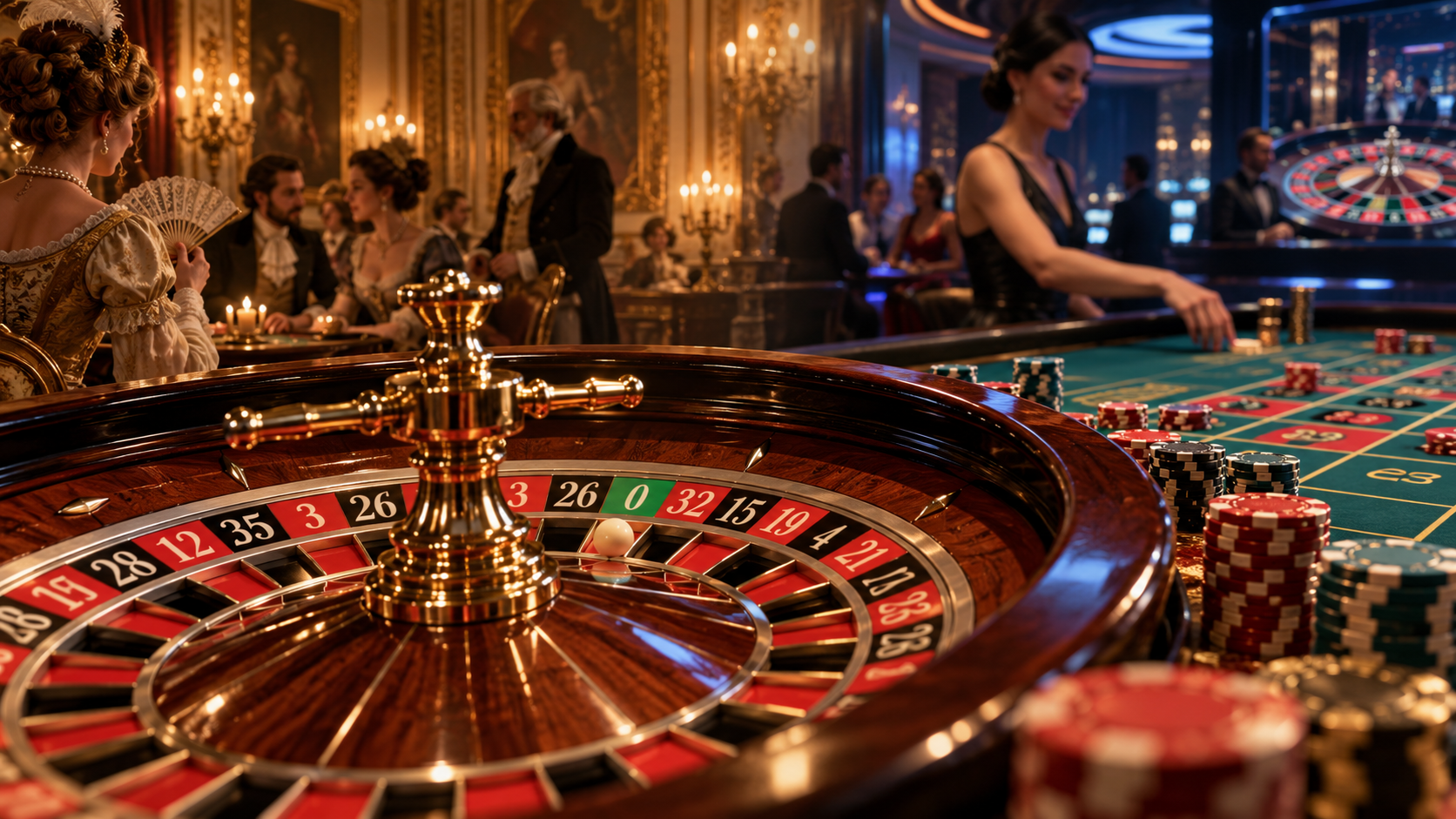
From Eighteenth-Century Salons to the Modern Casino
Roulette took recognisable shape in France during the eighteenth century, drawing on earlier wheel and betting games, and by the late 1790s it was associated with gaming rooms at Paris’s Palais-Royal. The game spread across Europe and beyond, picking up local variations while keeping the same central elements: a spinning wheel, a moving ball, and bets placed before the result is known.
A Small Wheel With a Long History
The name roulette means “little wheel,” a fitting description for a game that became a fixture of European gaming rooms. During the nineteenth century, it spread through established casino destinations and developed an identity built around risk, anticipation, and the brief pause before the result.
One Zero, Two Zeros, Different Mathematics
European roulette typically has 37 pockets numbered from 0 to 36, while the common American version has 38 because it includes both 0 and 00. That additional pocket changes the house edge, showing how a small difference in the wheel’s design affects the mathematics of the game.
| Feature | European roulette | American roulette |
| Numbered pockets | 37, including 0 | 38, including 0 and 00 |
| Single-number bet payout | 35 to 1 | 35 to 1 |
| Typical house edge | 2.70% | 5.26% |
| Key difference | One green zero pocket | Two green zero pockets |
Why the Format Still Works
Roulette is easy to follow compared with many modern casino games: choose a number or category, place a bet, and wait for the wheel to stop. That straightforward format has helped it move from traditional gaming rooms to online casinos and live dealer tables without losing its familiar character.
Simple Choices, Visible Consequences
The betting layout makes the connection between a choice and its possible outcome easy to understand. Straight-up bets offer a higher payout but cover only one number, while outside bets cover larger groups and pay less, creating a clear trade-off without offering a way to predict the result.
From Live Tables to Mobile Screens
Digital roulette recreates the wheel, betting layout, and countdown, while live dealer games add a real croupier and the rhythm of a physical table. Spinaway casino operate within this wider shift towards digital gaming, where familiar mechanics meet new ways of accessing entertainment.
| Bet type | Example | What it changes |
| Straight-up | One number | Higher payout, fewer covered outcomes |
| Split or corner | Two or four numbers | More numbers covered by one bet |
| Red or black | One colour | Covers many pockets, with zero affecting the result |
| Odd or even | One number group | A simple selection that remains subject to the zero pocket |
The Drama of Chance and the Limits of Strategy
Every spin delivers a result, but the wheel has no memory of what happened before. Several reds in a row do not make black more likely on the next spin, and increasing stakes after a loss does not remove the house advantage built into the game.
Research into gambling products also highlights the relationship between game design and player behaviour. A peer-reviewed study of gambling machine characteristics and player behaviour examined how features such as reward frequency and payout characteristics relate to betting activity on video lottery terminals; although the research focused on machine-based games rather than roulette, it illustrates why the design of a game matters alongside the way people engage with it.
From Casino Heritage to Digital Leisure
Roulette has endured because its rules stay consistent while every spin brings a different outcome. Online platforms can change the presentation, pace, and accessibility, but the central moment remains the same: bets are placed, the wheel turns, and attention follows the ball until it settles.
Conclusion
Roulette’s history shows how a simple game mechanic can cross centuries without losing its appeal. The ball drops into one pocket, the result is settled, and the next spin begins.