



By Tatiana Martins, journalist at G&M News.
There has been strong growth for the Poland iGaming market in 2025, with online casino games and sports betting among the main contributors to the sector’s expansion. At the same time, the estimated share of unlicensed activity continued to decline, highlighting progress in the country’s efforts to strengthen its regulated market.
According to data published by Poland’s Ministry of Finance in June 2026, total reported turnover across the country’s gaming and betting sectors reached PLN 117.35 billion (€26.64 billion) in 2025, up 24.65% from PLN 94.14 billion (€21.37 billion) in 2024. Online casino games recorded the largest increase in absolute terms, with turnover rising 34.45% year on year to PLN 68.02 billion (€15.44 billion). Online sports betting grew 14.17%, reaching PLN 18.75 billion (€4.26 billion). These figures represent turnover rather than gross gaming revenue (GGR), which measures stakes minus winnings paid to players.
The results highlight the commercial scale of Poland’s digital iGaming sector and the opportunities associated with its continued development. They also provide important context for evaluating the country’s regulatory framework, particularly its capacity to direct consumer demand towards authorized services.
Unlicensed market share declines as regulation develops
The Ministry of Finance’s latest assessment, based on data from market research company H2 Gambling Capital, found that the estimated share of unlicensed activity across Poland’s online casino market fell from 51.7% of GGR in 2018 to 27.5% in 2025.
Online sports betting segment also recorded a decline, with the calculated unlicensed share decreasing from 34% in 2018 to 22% in 2025. Online casino games registered a substantial long-term reduction, from 99.3% to 37.6% over the same period.
These figures indicate a significant change in the relationship between authorized operators and unlicensed providers since Poland introduced its current framework for online iGaming. The online casino segment still faces challenges, but the reduction in its estimated unlicensed share represents measurable progress in bringing activity into the regulated market.
The figures also place Poland’s performance in a wider European context. According to the same Ministry of Finance assessment, the average estimated unlicensed share across EU online markets was 32.8% in 2025, compared with 27.5% in Poland. The comparison excludes Luxembourg and Malta and uses country-level estimates compiled from H2 Gambling Capital data.
Although these figures do not establish that regulation alone caused the decline, they offer a useful indicator of market development. Continued monitoring will be important to determine whether the trend can be sustained as online demand grows.
A distinct framework for online casino games and sports betting
Poland operates different regulatory models for online casino games and sports betting. Under the country’s Gambling Act, online casino games are generally subject to a state monopoly operated by Totalizator Sportowy through its Total Casino platform. Private companies can obtain licenses to provide online sports betting, subject to Polish legal and regulatory requirements.
This structure shapes the competitive environment for operators and the options available to consumers. The licensed sports betting market accommodates multiple private companies, while the online casino segment remains centered on the state-operated platform.
The difference is relevant when assessing market performance. The Ministry of Finance estimates that the unlicensed share of online sports betting was 22% in 2025, compared with 37.6% for online casino games. The figures suggest that the two segments have followed different paths in bringing activity into the regulated framework.
For the iGaming industry, the next stage of development will depend on how effectively authorized services meet consumer demand while complying with Polish law. The figures also provide a basis for further discussion about the relationship between market structure, enforcement and the availability of legal online products.
Enforcement supports the regulated market
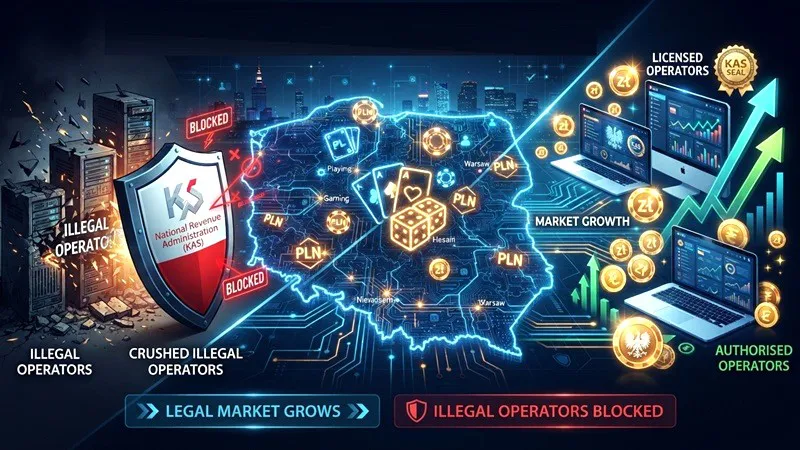
Poland has established mechanisms designed to restrict access to unauthorized gaming websites and disrupt their payment channels. The Ministry of Finance maintains a public register of domains used to offer or promote gaming services in breach of the law. Telecommunications providers must block access to listed domains within the statutory period, while payment service providers face restrictions on processing transactions connected with those websites.
The Ministry has also reported cooperation with the National Revenue Administration, the Polish Financial Supervision Authority and representatives of the banking sector to address unauthorized online gaming and related payment risks. In a response published in May 2026, the Ministry described its approach as involving systematic monitoring and enforcement under the existing legal framework.
These measures form part of the broader effort to protect the regulated market and limit the reach of operators that do not comply with Polish requirements. Their long-term effectiveness will depend on implementation, continued cooperation among authorities and payment providers, and the ability to respond to changes in how unauthorized websites operate.
For licensed businesses, effective enforcement helps maintain a clear distinction between authorized services and offers outside the national framework. Assessing the results requires more than counting blocked domains, however. Changes in the estimated unlicensed market share provide a broader indicator of progress.
Betting expansion creates opportunities for licensed operators
Poland’s market development provides a strong commercial backdrop for the discussion about regulation. Online casino turnover increased by PLN 17.43 billion (€3.96 billion) between 2024 and 2025, while online sports betting turnover grew by PLN 2.33 billion (€530 million), according to the Ministry of Finance. Both segments contributed to the overall increase in reported turnover.
The state-operated online casino has also continued to expand. In September 2026, Polish business publication Puls Biznesu reported that Totalizator Sportowy was preparing a second online casino platform. The report put Total Casino’s 2025 turnover at approximately PLN 68 billion (€15.44 billion) and its GGR at more than PLN 2.7 billion (€610 million), while the company anticipated double-digit growth in 2026. These company-specific figures were reported by the publication and should be distinguished from the ministry’s aggregate market statistics.
In this sense, the planned platform indicates that the state operator sees room for further development within the existing framework. Meanwhile, private sports betting operators continue to compete in their licensed segment, where product development, customer experience, and compliance remain important elements of their business strategies.
The market’s expansion makes the relationship between regulation and consumer demand a central issue for the industry. A declining unlicensed share, combined with growth in reported turnover, offers a constructive basis for assessing Poland’s regulated iGaming sector. The remaining unlicensed activity, however, shows that there is still room to strengthen the reach of authorized services.
Poland’s experience demonstrates that market growth and efforts to reduce unlicensed activity can be assessed together. The next challenge is to sustain the progress recorded in recent years and ensure that the legal market remains equipped to respond to changing consumer demand, technological developments, and regulatory expectations.