








By Diana Guerrero, journalist at G&M News.
The gambling industry in the European continent is preparing for a new regulatory framework designed to harmonize anti-money laundering (AML) requirements across the European Union. Regulation (EU) 2024/1624, published in June 2024, will generally apply from July 10th, 2027, establishing common obligations for businesses covered by the legislation.
For gambling operators, the changes make it important to assess existing compliance procedures, customer verification processes, and systems for identifying potentially suspicious transactions.
What changes in practice?
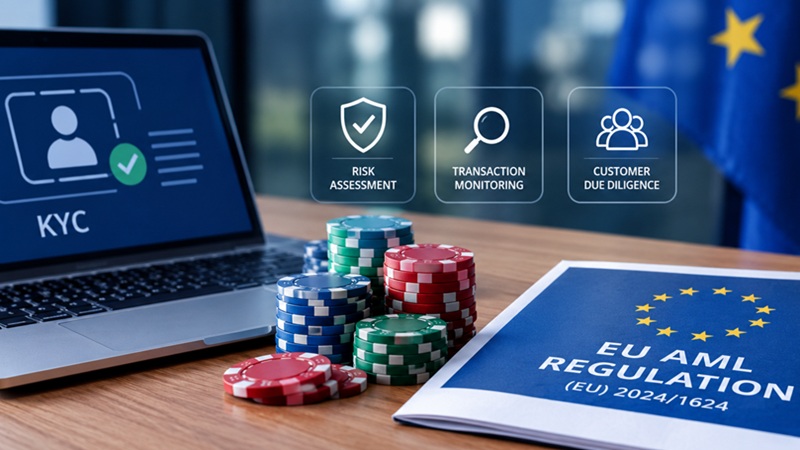
The regulation establishes customer due diligence requirements that apply in specified circumstances, including when certain transaction thresholds are reached. Key considerations for gambling operators include:
-€2,000 threshold: Customer due diligence requirements apply to gambling services when bets, the collection of winnings, or both reach €2,000 or more, whether through a single transaction or linked transactions, in accordance with the regulation.
-Customer due diligence: Operators must determine when identification and verification measures are required and ensure their procedures comply with the applicable rules.
-Risk-based controls: Businesses must assess money laundering and terrorist financing risks and apply appropriate measures based on the risks identified.
-Potential exemptions: Member States may grant full or partial exemptions to certain gambling service providers where the risks are demonstrated to be low and the conditions established by the regulation are met. These exemptions are not automatic and do not apply indiscriminately across the industry.
The €2,000 threshold should not be interpreted as a universal requirement to verify every customer before their first bet. The regulation sets out specific circumstances for applying due diligence, alongside requirements for monitoring transactions and identifying linked activity.
Balancing compliance and customer experience
Adapting to the new rules will require operators to review their internal processes while maintaining accessible customer experience.
In its analysis of the EU’s AML regulation for the gambling industry, Deloitte highlights the challenge of meeting compliance obligations without creating unnecessary friction for customers.
“The challenge is not simply meeting new AML requirements. It is doing so while preserving the customer experience,” says Dániel Bognár, Director at Deloitte Central Europe’s Gambling Centre of Excellence.
The firm identifies improvements to customer identification, transaction monitoring, data integration, and risk assessment as areas operators should consider when preparing for the new framework.
AMLA advances common technical standards
The European Union’s Anti-Money Laundering Authority (AMLA) is working to support a more consistent application of AML requirements across the bloc.
On October 1st, 2026, AMLA announced that it had finalized three sets of draft regulatory technical standards for the private sector. They address the identification of business relationships and linked transactions, customer due diligence, and group-wide AML arrangements.
The draft standards have been submitted to the European Commission. They will become applicable only after the relevant adoption and publication process, with the proposed timeline set out in AMLA’s announcement.
These standards are intended to clarify how businesses and supervisors should apply the new requirements consistently across the EU.
Preparing for the 2027 deadline
With the regulation generally scheduled to apply from July 10th, 2027, gambling operators should review their AML programs, customer due diligence procedures, transaction-monitoring systems, and risk assessments ahead of the deadline.
The regulation is directly applicable in EU Member States. Related provisions under Directive (EU) 2024/1640 follow a separate process requiring national transposition.
For the gambling sector, preparation will involve understanding which requirements apply to each business, documenting risk assessments, and ensuring that compliance controls reflect the operator’s activities and risk exposure.